
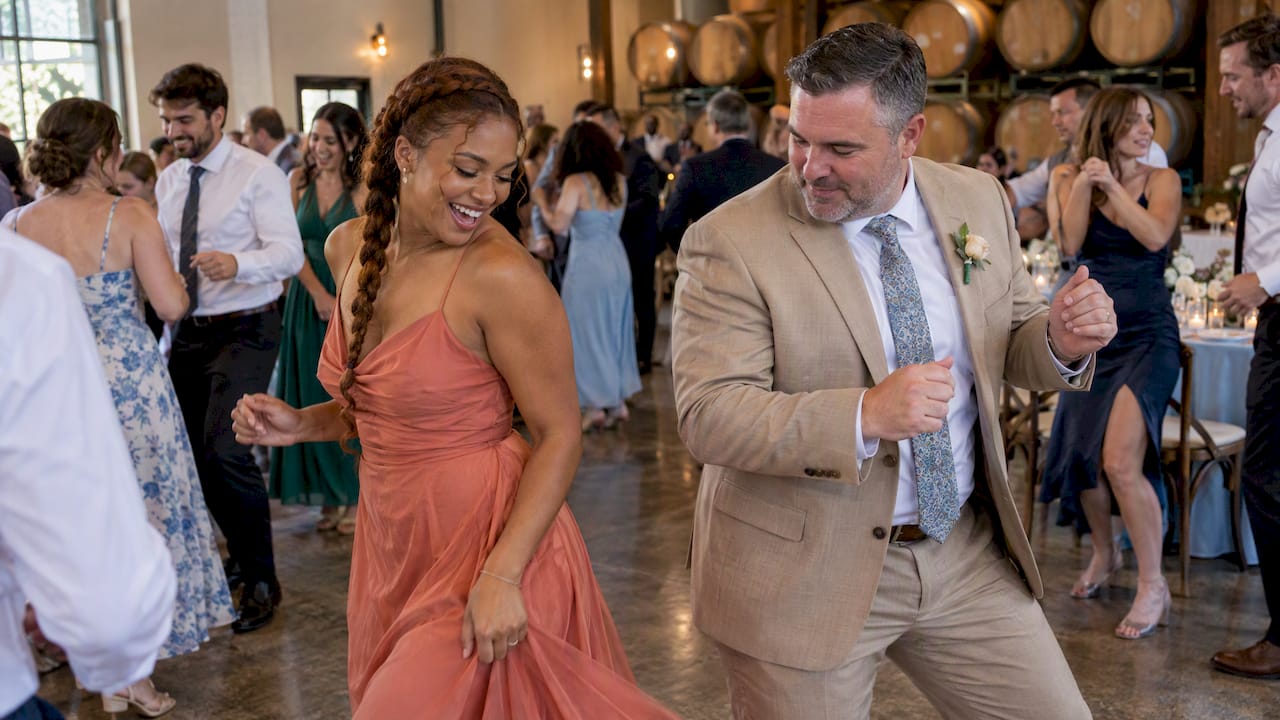
Choose a DJ if you want the widest song list, tight control of the timeline and a lower price. Choose a live band if you want a concert-style show and your budget and venue can handle it. Many couples land in between, with a band for part of the night and a DJ for the rest. We’re a San Antonio photo booth company, and we’ve seen the dance floor at thousands of receptions. Below is how the two options really differ and how to pick the one that fits your guests.
TL;DR
- Cost: The Knot’s 2026 study puts the average wedding DJ at about $1,689 and the average live band at $4,576 to $4,657, according to Rosevow’s summary of the data.
- Music: A DJ plays almost any song in its original recording. A band plays roughly 40 to 80 songs, live, with more visual energy.
- Space: A band can need 150 to 400+ square feet. A DJ needs about 4 to 8. Check your venue before you fall in love with a band.
- Best of both: A band followed by a DJ, or a DJ with live musicians, is a common and workable setup.
- Guest energy: Whichever you pick, add something for guests to do between dances, like a photo booth.
Table of Contents
- The Short Answer: Which Is Right for You?
- How the Atmosphere Differs
- What a Wedding DJ and a Band Cost
- Space, Setup and Timing at Your Venue
- Where Mariachi Fits
- Can You Hire Both?
- A Simple Decision Guide
- Perspective: What We See From the Other Side of the Dance Floor
- Keep Guests Smiling Between Songs
- Questions to Ask Before You Sign
- FAQ
- Sources
The Short Answer: Which Is Right for You?
Start with three questions.
- What do you want guests to remember? If it’s a show, a band. If it’s a full dance floor singing along to the songs they know, a DJ.
- What does your venue allow? Space, power and sound limits can decide this for you.
- What does your budget look like after the venue and catering? Entertainment typically takes 5 to 10% of a wedding budget, and 10 to 15% is reasonable if music and dancing are your priority, according to Rosevow.
If you answered “a show, yes, and yes,” book the band. If you answered “a packed dance floor, maybe not, and tight,” book the DJ. If it’s a mix, keep reading, because the hybrid option may be your answer.
How the Atmosphere Differs
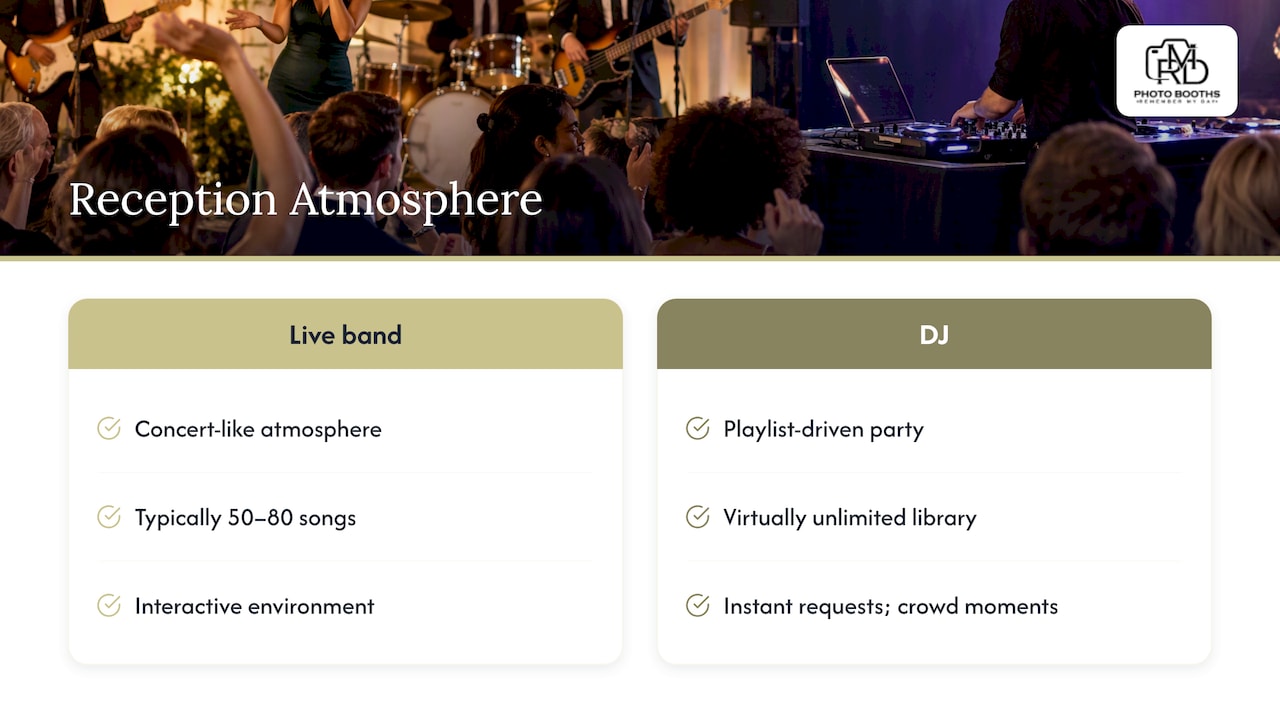
A live band gives your reception a concert feel. Guests watch musicians play, the drummer feeds the energy, and the vocalist works the crowd. Paperlust’s comparison describes this as a visual, concert-like atmosphere, but notes the repertoire is typically 50 to 80 songs.
A DJ gives your reception a playlist-driven party. The same source notes a DJ has a virtually unlimited library and can play requests instantly, which suits couples who want the exact recorded versions of their favorite songs.
Vendors who work both sides describe the difference well. One Minneapolis venue sales manager told Minnesota Bride that a DJ can read a room and get the party going, while a band creates a more interactive environment. Another entertainer in the same piece pointed out that DJs are practiced at crowd participation moments, while some bands don’t know how to run a bouquet toss or garter throw.
That last point matters. Your reception isn’t only dancing. It also includes introductions, toasts, the first dance, the cake cutting and the last song. Someone has to run those smoothly.
Choose a DJ if you want
- Hits from any decade, in the original recordings
- Quick pivots between genres when the crowd shifts
- A single person acting as emcee and timeline keeper
- Quiet, compact equipment in a small or tricky room
Choose a band if you want
- Live instruments and a visual centerpiece
- Musicians who interact with your guests
- A few signature songs reimagined live
- A reception that feels more like an event than a playlist
What a Wedding DJ and a Band Cost
Cost is where most couples make the call, so here are the numbers.
| Wedding DJ | Live band (4 to 5 pieces) | Show band (7 to 9 pieces) | |
|---|---|---|---|
| Typical national price | About $1,689 average | $3,500 to $7,500 | $7,500 to $14,000 |
| Overall band average | n/a | $4,576 to $4,657 | n/a |
These figures come from The Knot’s 2026 Real Weddings Study, which surveyed 10,474 couples married in 2025, as summarized by Rosevow. The gap is easy to explain: you’re paying one or two people in one case and a whole team in the other.
What pushes the price up
- Date. Peak Saturdays in May, June, September and October can command a 20 to 40% premium over base rates for both DJs and bands, per the same Rosevow guide.
- Extras for bands. Overtime fees, travel for performers, meals for the band and crew, custom song arrangements and specialized lighting or equipment rentals can all add up, according to My Wedding Source.
- Big-city markets. New York, Los Angeles and Miami often run well above national averages, according to Sortra. Your own city may differ, so get local quotes.
One habit saves couples from surprises: ask for an itemized proposal. Event planners consistently recommend this to uncover equipment, travel or union fees that don’t show in a base package, as Livent Group notes.
Space, Setup and Timing at Your Venue
This is the section couples skip and then regret. A band is a physical footprint.
- Space: A live band may need 150 to 400+ square feet depending on size, while a DJ typically needs 4 to 8 square feet, per Paperlust.
- Power and access: A four-piece band typically wants about 10 by 20 feet of clear floor, a separate electrical circuit, clear vehicle access for loading in, and venue access two to three hours before guests arrive, according to BandCalendar.
- Sound limits: Venues often enforce noise limiters, and those are easier for a DJ to manage than for a band with live drums and amps, as Greenlight Bands explains. The same source says performers generally need loading access, clear performance timing and often a vendor meal.
- Technical rider: Many venues ask bands for a technical rider that lists power, staging and space needs. Sortra suggests reviewing it before you sign.
The practical move is simple. Before you book either option, ask your venue manager for the dance floor dimensions, power details, sound curfew and load-in rules. Then share them with every entertainer you consider.
Also think about the rest of the floor plan. Dance floor, tables, a bar, and any guest activity like a photo booth all compete for the same room. A DJ’s small footprint leaves more room for those extras.
Where Mariachi Fits
If you’re searching for mariachi versus a DJ, you’re likely in one of two camps: you want mariachi as the main music, or you want it as a moment. In South Texas, mariachi is deeply woven into celebrations, and we love seeing it at weddings.
One mariachi booking service says the music is strongest at guest arrival, after the ceremony, during cocktail hour, over dinner, or as a focused reception feature, and that it suits celebrations where families travelling from different cities need a shared gathering point (HireMariachis). It also advises giving the band a clear place in the timeline, since a set that’s too early may be missed and one that’s too late can collide with the DJ’s schedule.
So a common plan looks like this:
- Mariachi plays during the cocktail hour or a dedicated 30 to 45 minute set at dinner.
- The DJ takes over for the dance portion, with the full library, the toasts and the final send-off.
Mariachi rarely replaces a DJ for four hours of dancing across genres, but it makes a memorable feature. Treat it like a band: confirm space, power and the exact time in the schedule.
Can You Hire Both?
Yes. This is more common than most couples expect.
One working wedding band explains that a DJ can take over as the band finishes its last song before a break and play songs outside the band’s repertoire (The Femmes). That keeps the floor full while the musicians rest.
There’s also a newer option. Phase 2 Events describes a hybrid setup, where a DJ performs with live musicians such as saxophone players, violinists, percussionists or drummers. It feels more interactive than a standard DJ set while keeping the flexibility and nonstop flow.
Hybrid works well when:
- You love live music but can’t afford a full band for four hours
- Your venue is small and can’t host a whole stage
- Your guests span generations and genres
Tell both vendors about each other early so they can agree on handoffs, volume levels and who emcees.
A Simple Decision Guide
| Your situation | Likely best fit |
|---|---|
| Tight budget, big guest list, wide age range | DJ |
| Small venue or strict noise limits | DJ |
| You want a show and the room supports it | Band |
| Specific original recordings matter to you | DJ |
| You want live energy without full-band cost | Hybrid DJ with live musicians |
| Cultural tradition like mariachi matters | Mariachi feature plus DJ |
Whatever you choose, interview at least two or three entertainers. Ask to see them perform in person or on video, ask for a full itemized quote, and ask how they handle announcements and special moments.
Perspective: What We See From the Other Side of the Dance Floor
We don’t play the music at your wedding, but we see what happens around it, and we’ve worked more than 5,000 events. Here’s what we’ve noticed.
A great dance floor is only part of a great reception. Guests dance in waves. Between those waves, they want something to do with the people they love. That’s the moment when a photo booth turns a lull into a laugh, and it works the same way whether your music comes from a DJ or a band.
That’s why we build our experiences around your celebration. We offer traditional, vintage, glam and 360° booths, plus roaming and robot booths and audio guest books. Our traditional booth, glam booth and 360 booth are designed to give guests something fun to do while the music keeps going.
Our advice: book your music first, because it shapes the room. Then tell us your layout, and we’ll help you fit a booth so it adds to the energy without crowding the dance floor.
RMD
Keep Guests Smiling Between Songs
Once your music is booked, think about what guests do during cocktail hour, between sets, and while the band takes a break. That’s where we come in.
We provide photo booth rentals for weddings across San Antonio, and our prices are published for each booth, as one-time fees per event:
- Audio Guest Book: from $275
- Selfie Booth: from $625
- Roaming Booth: from $650, so no one has to leave the dance floor
- Traditional Booth: from $900
- Glam Booth: from $1,000
- 360 Booth: from $1,295
Final pricing depends on booth type, event length and add-ons like branding and custom overlays.
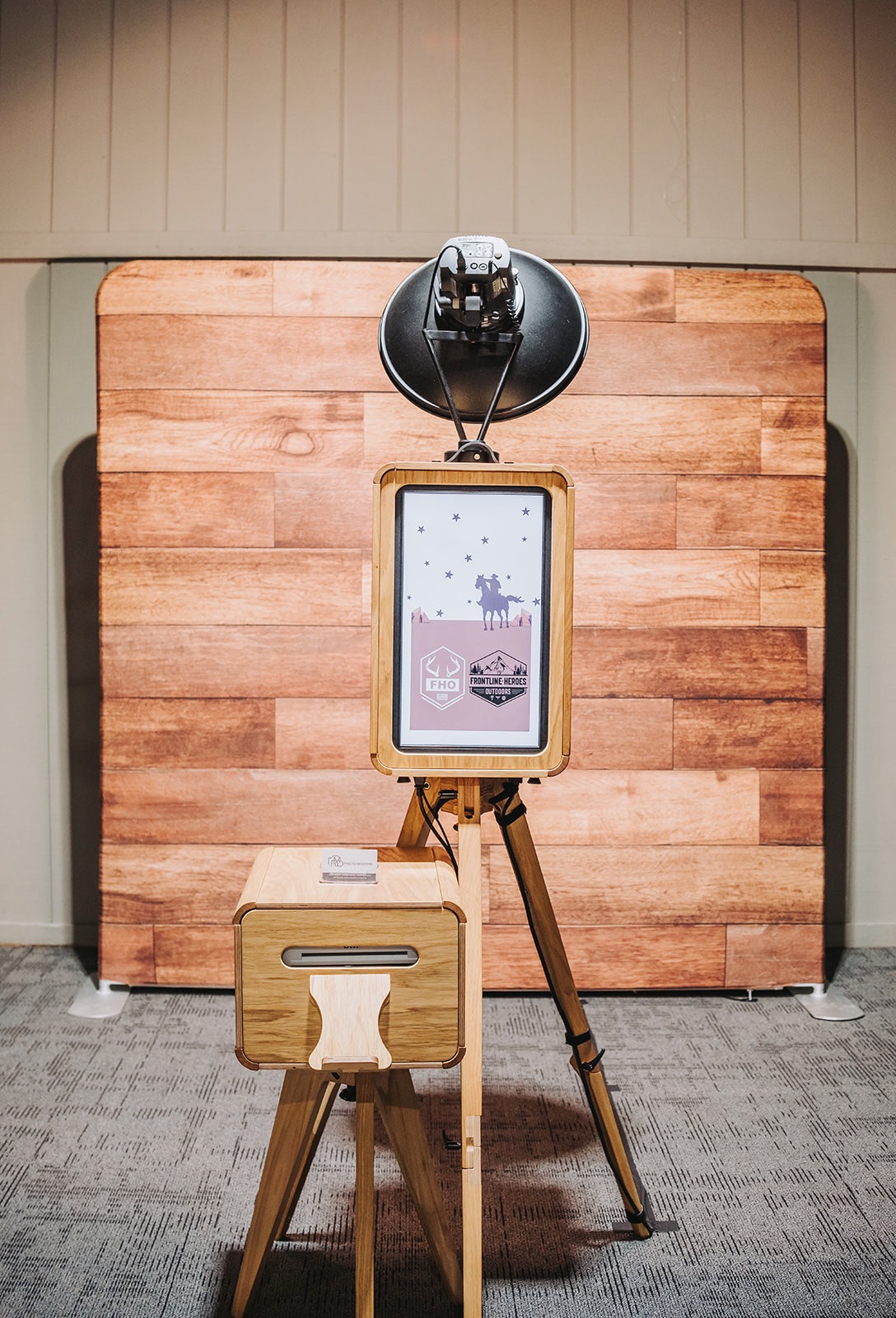
Ready to check your date? Book your photo booth here, or browse all of our booth experiences first. If you want ideas for what keeps guests engaged, our look at wedding photo booths and guest engagement is a good place to start.
Questions to Ask Before You Sign
Use this list with every DJ, band or hybrid act.
- What exactly is included, and what’s extra (overtime, travel, meals, lighting)?
- How much floor space, power and setup time do you need?
- Will you act as emcee for introductions, toasts and the cake cutting?
- How do you handle requests and do-not-play lists?
- What is your backup plan if someone is sick or equipment fails?
- Who will actually perform at my wedding, not just in your promo video?
- How do you coordinate with other vendors, such as a band with a DJ?
And always confirm the date, hours and total price in a written contract.
FAQ
Is a DJ or a band better for a wedding?
Neither wins every time. A DJ suits couples who want a huge song library, exact recordings, flexible timing and a lower cost. A band suits couples who want live energy and have the budget and space. Your venue’s size and sound rules often settle it.
Is a wedding DJ cheaper than a band?
Usually, yes. The Knot’s 2026 study, as summarized by Rosevow, shows an average of about $1,689 for a DJ against roughly $4,576 to $4,657 for a band. Bands often add costs for travel, meals and equipment, so request an itemized quote.
Can I have a live band and a DJ at the same wedding?
Yes. A common approach is a band for the first part of the dance set and a DJ for the rest, with the DJ picking up when the band takes a break. You can also book a DJ who performs with live musicians like a sax player or percussionist.
How much space does a band need compared with a DJ?
A band may need 150 to 400+ square feet depending on size, while a DJ typically needs 4 to 8 square feet, according to Paperlust. Confirm power, load-in access and noise limits with your venue before booking.
Sources
- Wedding DJ vs Live Band: The Complete 2026 Guide, Rosevow
- Wedding Band vs DJ: Cost, Pros and Cons, Paperlust
- Band or DJ? How to Pick Your Wedding Music, Minnesota Bride
- Wedding Band vs DJ Cost, My Wedding Source
- How Much Does Wedding Music Cost, Sortra
- How Much Does a Live Band Cost, Livent Group
- Live Band vs DJ for Weddings, Greenlight Bands
- Live Band vs DJ for Weddings, BandCalendar
- Mariachi Bands, HireMariachis
- FAQs and Tips for Hiring a Live Wedding Band, The Femmes
- The Rise of the Hybrid DJ, Phase 2 Events
Recommended
- Wedding Trading Card Booth: A Couple’s Guide for 2026
- How to Choose the Perfect Wedding Photo Booth in San Antonio
- Audio Guest Book Prompts: What to Ask Your Guests
This article was created with the assistance of automated AI content tools using publicly available information and may contain errors, omissions, or outdated information. Content is provided for general informational purposes only and does not represent an endorsement, criticism, or official statement regarding any person, business, product, or service mentioned. Business details, pricing, services, availability, and other information may change over time. If you believe any information is inac