
TL;DR:
- Smart event booths use AI, RFID, and spatial computing to capture real-time visitor data and enhance engagement. They improve lead quality, increase dwell time, and strengthen brand perception by combining active and passive technologies. Proper design focuses on visitor experience and reliable infrastructure to maximize results and post-event follow-up.
A smart event booth is defined as a technology-integrated interactive space that combines AI, RFID tracking, touchscreens, and spatial computing to transform passive displays into measurable engagement environments. Unlike traditional setups, these booths capture real-time visitor data, qualify leads automatically, and adapt content based on attendee behavior. The industry term you will encounter most often is “intelligent exhibition stand,” though “smart event booth” is the widely used shorthand among planners. Smart event booths integrate AI chatbots, spatial computing, and RFID to create structured, measurable visitor journeys. For event organizers focused on guest experience and measurable ROI, understanding this technology is the first step toward booking experiences that truly deliver.
What are smart event booth features and core technologies?
Smart event booths rely on a layered set of technologies, each serving a specific function in the visitor journey. The most effective booths combine passive and active systems to maximize reliability and engagement depth.
Active engagement technologies respond directly to visitor input:
- AI chatbots and virtual assistants answer questions, qualify leads, and guide visitors through product information without requiring staff at every moment.
- Touchscreen kiosks let visitors self-navigate content, register interest, or enter contests, creating a personalized path through the booth.
- Augmented reality (AR) and virtual reality (VR) place visitors inside a product experience, a venue, or a branded world. This is particularly effective for products that are too large or complex to display physically.
- QR code and NFC tap interactions trigger digital content instantly when a visitor scans or taps, connecting physical objects to digital experiences.
Passive engagement technologies work without visitor action:
- RFID-embedded furniture and walls track visitor movement and dwell time without requiring any interaction from the guest.
- Passive NFC integrated in furniture avoids the risks of complex AV system failures and requires far less power than screen-heavy setups.
The infrastructure layer matters just as much as the visible technology. Edge computing is essential for real-time sensor data processing and 3D rendering. Relying on venue Wi-Fi causes failures at the worst possible moments. Smart booth operators run localized networks at or near the booth to keep every interaction fast and uninterrupted.
Pro Tip: When evaluating booth technology, ask your provider whether their system runs on edge computing or depends on venue internet. The answer tells you everything about reliability under pressure.
Spatial computing represents the next level of smart event booth design. AI and spatial computing dynamically adapt content in real time based on attendee focus and movement. The booth becomes a responsive ecosystem rather than a static display.
How do smart event booths work to capture data and manage leads?
The operational flow of a smart event booth moves through four clear stages: attract, interact, capture, and qualify.
- Attract. Spatial sensors and motion-triggered displays detect nearby visitors and activate content. A visitor walking past triggers a screen to shift from a screensaver to a targeted message.
- Interact. The visitor engages through a touchscreen, AR experience, AI chat, or NFC tap. Each interaction is logged with a timestamp and session ID.
- Capture. Badge scanning, QR code registration, or NFC tap links the visitor’s identity to their interaction history. Badge scanning and QR qualification can qualify leads in under 10 seconds, even without reliable Wi-Fi. That speed matters enormously at high-traffic conferences.
- Qualify. AI chat tools ask pre-set questions during the interaction, scoring each lead automatically based on responses. Hot leads surface immediately in the analytics dashboard.
The data collected flows into a real-time dashboard that event staff can monitor throughout the day. Organizers see which content draws the longest dwell time, which products generate the most inquiries, and which visitor segments engage most deeply.
Post-event, the data feeds directly into CRM systems and marketing platforms for follow-up. 62% of exhibitors use dedicated lead capture apps in 2026 to accelerate follow-ups. That adoption rate reflects how central digital capture has become to trade show ROI.
One critical operational point: transparency about data collection is not optional. Clear signage about behavioral tracking improves attendee opt-in rates and builds trust. More opt-ins mean richer data. Compliance and engagement go hand in hand.
| Stage | Technology used | Output |
|---|---|---|
| Attract | Motion sensors, spatial displays | Visitor enters booth zone |
| Interact | Touchscreen, AR, AI chat | Session data logged |
| Capture | Badge scan, QR, NFC tap | Identity linked to session |
| Qualify | AI scoring, CRM sync | Ranked lead delivered to sales |
What measurable benefits do smart event booths offer organizers?
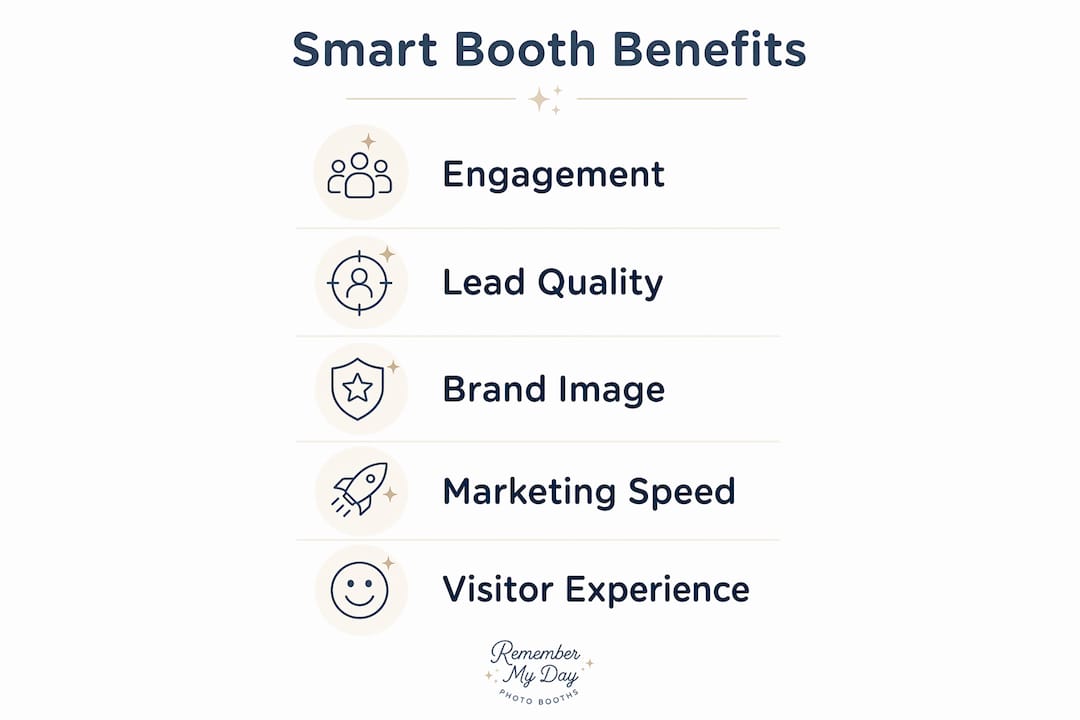
Smart event booths produce outcomes that traditional booths cannot match across four key areas.

Visitor dwell time increases. Interactive content gives visitors a reason to stay longer. A visitor who spends three minutes at a booth instead of 30 seconds is far more likely to remember the brand and respond to follow-up. AR and VR experiences are particularly effective at extending time on site because they require active participation.
Lead quality improves dramatically. Manual badge collection produces a list of names with no context. AI-qualified leads arrive with interaction history, stated interests, and a priority score. Sales teams spend time on the right conversations instead of cold-calling every badge scan. For event planners managing customizable event booths for corporate clients, this difference directly affects client satisfaction and repeat bookings.
Brand perception shifts. Visitors associate technology-forward booths with forward-thinking brands. The experience itself becomes a brand statement. A well-designed smart booth signals that the exhibitor invests in quality and takes the visitor’s time seriously.
Post-event marketing accelerates. Real-time data means the sales team can begin outreach before the event ends. Segmented visitor lists allow personalized follow-up emails based on what each visitor actually interacted with. That specificity lifts response rates well above generic post-show blasts. Planners who want to maximize this effect can explore booth engagement strategies that align technology choices with follow-up workflows.
For events that also incorporate branded merchandise, coordinating booth technology with custom event apparel creates a unified brand experience that visitors carry home, extending the booth’s reach beyond the event floor.
What are the best practices for designing a smart event booth?
The most common mistake in smart booth design is treating technology as the centerpiece rather than the support structure. Technology should support the visitor journey, not serve as the main attraction. A booth packed with screens and gadgets but lacking a clear visitor path wastes both budget and attention.
Best practices that consistently produce strong results:
- Map the visitor journey first. Decide what you want a visitor to know, feel, and do before selecting any technology. Every tech choice should serve one of those three goals.
- Balance technology with human presence. AI chat handles volume, but a knowledgeable staff member closes conversations. The role of booth attendants remains critical even in the most automated setups.
- Plan for power and network independence. Run your own power distribution and localized network. Never assume the venue will provide adequate infrastructure for real-time interactive experiences.
- Use spatial pre-mapping for immersive experiences. Spatial mapping and sensor calibration require detailed 3D pre-mapping of the booth structure. Skipping this step produces misaligned AR overlays and broken sensor zones.
- Post clear data collection notices. Signage explaining what data is collected and how it is used increases opt-in rates and satisfies brand governance requirements.
- Avoid technology overload. Two or three well-integrated technologies outperform six competing systems every time. Visitors do not want a tutorial. They want an experience.
Pro Tip: Run a full dry-run of every interactive element 24 hours before the event opens. Technology failures discovered during setup are fixable. Failures discovered during peak traffic are not.
For planners building out interactive booth features, the principle is the same whether the event is a trade show, a wedding, or a corporate celebration. The technology serves the moment, not the other way around.
Key Takeaways
Smart event booths deliver measurable engagement and lead quality gains when technology is selected to serve the visitor journey rather than impress on its own.
| Point | Details |
|---|---|
| Define the visitor journey first | Map what visitors should know, feel, and do before choosing any technology. |
| Edge computing prevents failures | Run localized networks at the booth to avoid dependence on unreliable venue Wi-Fi. |
| Transparency increases opt-ins | Clear data collection signage builds trust and produces richer, more complete engagement data. |
| AI qualification speeds lead follow-up | Automated lead scoring lets sales teams prioritize outreach before the event ends. |
| Balance tech with human interaction | Staff members close conversations that AI chat opens, making both more effective together. |
What I have learned from watching smart booths succeed and fail
After working with event organizers across hundreds of setups, the pattern is consistent. The booths that generate the most excitement on the floor are rarely the ones with the most screens. They are the ones where every technology choice connects to a specific moment in the guest experience.
I have watched exhibitors spend significant budgets on VR headsets that sat unused because the line to try them was too long and the experience too disconnected from the brand message. I have also watched a simple NFC-enabled table card generate hundreds of qualified leads at a fraction of the cost, because it fit naturally into a conversation a staff member was already having.
The most important shift happening right now is the move toward spatial computing as a practical tool rather than a novelty. When AI adapts booth content in real time based on where visitors are standing and what they are looking at, the booth stops being a display and starts being a conversation. That is the direction the industry is heading, and planners who understand it now will design far better experiences in the next two years.
Interoperability is the other factor most planners underestimate. A smart booth that cannot export its data cleanly into your CRM or marketing platform produces insights that die on the event floor. Before committing to any technology stack, confirm the data handoff. The value of smart booth data lives entirely in what happens after the event ends.
— RMD
How Rmdphotobooths brings smart booth experiences to life
At Rmdphotobooths, we have spent years helping event planners in San Antonio and beyond create those “wow” moments that guests treasure long after the event ends. Our booth experiences go well beyond a camera and a backdrop.

From AI-powered watercolor portraits to 360° video booths, our smart booth experiences are built around the same principles this article covers: clear visitor journeys, technology that serves the guest, and memories worth keeping. We bring the technology, the setup, and the expertise so you can focus on your guests. With over 1,000 five-star reviews, we know what makes an event unforgettable. Ready to bring that energy to your next event? Book your booth and let us help you create something your guests will talk about for years.
FAQ
What is a smart event booth?
A smart event booth is an interactive space that integrates technologies like AI, RFID, touchscreens, and spatial computing to capture real-time visitor data and create measurable engagement experiences.
How do smart event booths capture leads?
Smart booths capture leads through badge scanning, QR code registration, and NFC taps, then qualify them automatically using AI scoring tools. Leads can be ranked and delivered to sales teams in under 10 seconds.
What technology do smart event booths use?
Smart event booths use a combination of AI chatbots, RFID and NFC sensors, AR and VR displays, edge computing networks, and real-time analytics dashboards to create responsive visitor experiences.
Are smart event booths reliable at large events?
Reliability depends on infrastructure. Booths that run on localized edge computing networks rather than venue Wi-Fi maintain consistent performance even at high-traffic events with thousands of attendees.
What is the biggest mistake in smart booth design?
The biggest mistake is treating technology as the main attraction rather than a support tool for the visitor journey. Technology without a clear purpose wastes budget and confuses guests.