
TL;DR:
- Understanding wedding booth terminology is essential for coordinating vendors effectively and avoiding surprises on your special day.
- Different booth types, like traditional enclosed or open-air, create unique guest experiences and require specific setups and power supplies.
Planning a wedding is thrilling, but the moment a vendor drops terms like “open-air setup,” “GIF booth,” “print strip,” or “breakdown window” into a proposal, the excitement can give way to real confusion. Understanding wedding booth terminology is not just helpful. It is the difference between a seamlessly coordinated reception and a day full of last-minute logistics surprises. This guide walks you through the most important photo booth language, booth setup vocabulary, and pricing concepts so you can make confident decisions, ask the right questions, and create guest experiences that everyone will treasure forever.
Table of Contents
- Key takeaways
- Core wedding booth terminology: types and features
- Setup, props, prints, and digital delivery terms
- Pricing terminology and cost factors
- How booth terminology fits into broader event planning
- My take: why this vocabulary really matters
- Create unforgettable memories with Rmdphotobooths
- FAQ
Key takeaways
| Point | Details |
|---|---|
| Know your booth types | Each booth type has different footprints, lighting needs, and guest throughput speeds that affect your event flow. |
| Clarify print vs. digital | Print-heavy packages slow guest queues while digital-first delivery keeps traffic moving smoothly. |
| Ask for all-in pricing | Request total costs including delivery, setup, and overtime fees to avoid unexpected charges. |
| Keep booth ops separate | Photo booth operations function as an independent track from wedding photography, requiring distinct scheduling. |
| Match terms to operations | Aligning booth vocabulary with real operational differences makes vendor coordination faster and clearer. |
Core wedding booth terminology: types and features
When vendors start describing booth options, the names alone can feel like a foreign language. Let’s break each one down clearly so you can match the right choice to your venue, guest count, and vision.
Common wedding photo booth types include traditional enclosed booths, 360 booths, and selfie stations, and each one creates a completely different guest experience. Here is a comparison table to make the differences concrete:
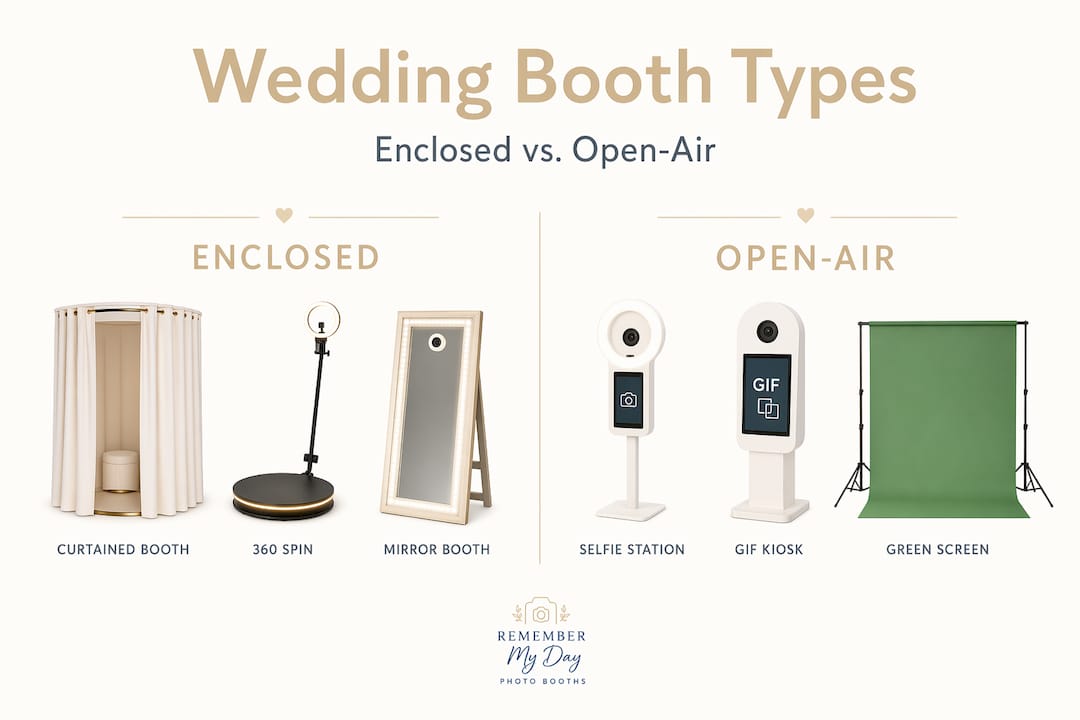
| Booth type | Enclosure | Output format | Footprint | Best for |
|---|---|---|---|---|
| Traditional enclosed | Yes | Photo strips, prints | 5×5 ft | Intimate, classic feel |
| Open-air | No | Prints, digital | 8×8 ft | Large groups, airy spaces |
| Mirror booth | No (reflective screen) | Prints, animated GIFs | 4×6 ft | Glam, upscale receptions |
| 360 spin booth | No | Boomerang video clips | 12×12 ft | High-energy receptions |
| Selfie station | No | Digital only | 3×3 ft | Budget-conscious, casual events |
Traditional enclosed booths give guests a curtained or walled space, professional studio lighting, and instant photo strips. They hold two to four people comfortably. Open-air booths remove the enclosure entirely, making room for larger groups and giving photographers the freedom to customize backdrops without restriction. Mirror booths use a touchscreen reflective panel to guide guests through poses, producing prints and animated GIFs. The 360 spin booth places guests on a rotating platform while a camera arm circles them, producing slow-motion video clips guests love sharing. Finally, a selfie station is essentially a tablet or smartphone on a stand, skipping the professional camera entirely and delivering digital photos only.
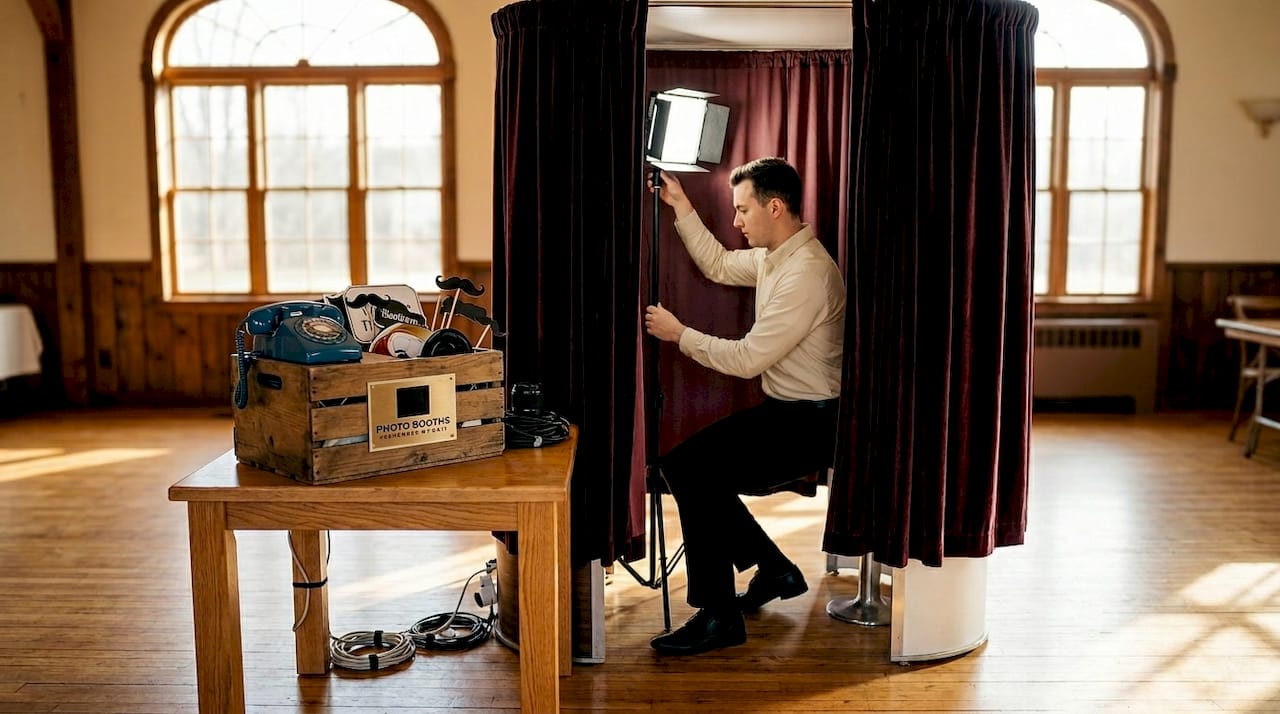
Each type also carries different power requirements. The 360 spin booth, for example, typically needs a dedicated 20-amp circuit. Knowing this before your venue walkthrough saves real headaches on the wedding day.
Setup, props, prints, and digital delivery terms
Once you have chosen a booth type, the next round of photo booth language kicks in. These are the terms that shape what guests actually experience from the moment they walk up to the booth to when they leave with a keepsake.
Here are the key terms every event planner should know:
- Backdrop: The decorative background behind guests. Options include fabric drapes, sequin panels, floral walls, balloon installations, or printed vinyl. Backdrops are often swappable, and some vendors offer multiple backdrop changes during an event.
- Props box: A curated collection of physical accessories, typically 30 to 50 items like hats, glasses, and signs. Themed or custom props usually cost an extra $50 to $100 beyond the base rental.
- Instant print: A photo output delivered within seconds of capture, usually a 2×6 or 4×6 print. Some booths offer both formats and let guests choose.
- Print strip: The classic two-column series of photos, typically four frames, that comes out of a traditional booth. This is the output most associated with the “photo booth” experience.
- Digital gallery: An online album where all booth photos are uploaded and shared after the event. Guests access it via a QR code or a link texted to them in real time.
- GIF: A looping animated image made from a rapid sequence of still shots. GIFs are shareable on social media instantly and work best with open-air and mirror booths.
- Boomerang: A back-and-forth looping video clip, common with 360 booths.
- On-site attendant: A trained booth team member who manages the booth throughout the event. Attendants manage the booth, assist guests, restock supplies, and troubleshoot any technical issues.
- Setup window: The time block before the event when the vendor arrives and assembles the booth. Usually 60 to 90 minutes before guest arrival.
- Breakdown window: The post-event period for disassembly and pickup, typically 30 to 60 minutes after the last photo.
Pro Tip: Always confirm with your vendor whether the on-site attendant is included in the base price or billed as an add-on. For mirror and 360 booths, an attendant is often mandatory because of the technical complexity involved.
Digital sharing via QR codes or online galleries allows quick photo access, making it a smarter choice for high-traffic receptions where you want guests cycling through the booth quickly rather than waiting at a printer.
Pricing terminology and cost factors
Pricing proposals are where unclear event booth glossary knowledge costs you the most. Vendors use specific terms that seem interchangeable but carry real financial differences.
Here is a numbered breakdown of what to understand before you sign anything:
- Base rental rate: The starting price for a specific booth type during a set hours window. For a standard three-hour rental, typical rental prices in 2026 range from $400 for a traditional booth to $1,500 for a 360 spin booth.
- Delivery fee: A charge for transporting the booth to and from your venue. Expect $75 to $200 depending on distance.
- Setup fee: Separate from delivery, this covers the labor of assembling and testing the booth. Fees typically run $50 to $150.
- Overtime rate: The per-hour charge if you extend the booth beyond the contracted rental window. Budget $100 to $250 per additional hour.
- All-in pricing: A quote that bundles delivery, setup, breakdown, props, and the attendant into one number. This is the format you want. Requesting all-in pricing avoids unexpected vendor charges and makes cost comparisons accurate.
- Print package: A pricing tier that includes unlimited physical prints during the rental period. Print packages cost more than digital-only options but produce tangible keepsakes guests take home.
- Digital-first package: A lower-cost option where guests receive only digital copies, shared via text, email, or QR code gallery, with no physical prints.
Hidden costs including vendor setup fees, overtime, and delivery charges catch planners off guard more than almost any other expense category in the wedding budget. Always request a fully itemized quote and ask directly whether the listed price includes every line item above.
Pro Tip: When comparing vendors, ask each one: “What is the total cost for my event, including delivery, setup, breakdown, attendant, and overtime if I run 30 minutes long?” That single question surfaces every potential hidden fee in one conversation.
How booth terminology fits into broader event planning
Here is where wedding photography jargon and photo booth language start to overlap in ways that confuse even experienced planners. Understanding the distinction between these two worlds makes coordination much smoother.
A photo booth station is distinct from the couple’s official wedding photography, staffed by a booth attendant rather than the couple’s photographer. These are parallel operations, not the same service. Treating them as separate tracks is what keeps your event timeline clean.
A few distinctions worth knowing:
- Booth attendant vs. second shooter: A booth attendant manages the photo booth, assists guests, and resets props. A second shooter is an additional wedding photographer assisting the lead photographer during the ceremony and reception. They are different roles with different responsibilities.
- Event flow: The sequenced timeline of your reception. Where you place the photo booth within your floor plan and schedule affects guest engagement and traffic patterns near the dance floor and bar.
- Vendor load-in: The collective window when all vendors arrive to set up. Coordinating booth setup within load-in prevents bottlenecks at the venue entrance.
- Guest throughput: How many guests can use the booth per hour. Traditional booths handle roughly 40 to 60 guests per hour. Open-air booths run faster. 360 booths, because of the production involved, run slower, typically 20 to 30 guests per hour.
Coordinating photo booth logistics separately from the main wedding photography schedule genuinely improves event flow and reduces vendor confusion. Give the booth its own block in your run-of-show document, and share it with your venue coordinator, DJ, and booth vendor independently. This small habit saves enormous coordination time on the day itself.
For more on photo booth types for weddings, matching the right format to your specific venue and guest count makes a measurable difference in how much guests actually use and enjoy the booth.
My take: why this vocabulary really matters
I have watched so many planners walk into vendor calls underprepared on booth language, and the results are predictable. Proposals come back with vague line items, delivery fees appear on final invoices, and the booth ends up placed in a corner that kills guest traffic. None of that has anything to do with choosing the wrong booth type. It comes down to not having the vocabulary to ask the right questions early.
What I have found in working with hundreds of events is that planners who understand the terminology create better weddings. Not because the terms are magical, but because they shift the power dynamic. When you ask a vendor about guest throughput on a 360 booth or whether the breakdown window is included in the contracted time, you signal that you know the field. Vendors respond to that with clearer answers, more accurate quotes, and better service.
The other thing I have learned: do not confuse a great booth experience with a beautiful booth. A gorgeous sequin backdrop paired with a booth that prints slowly and has no attendant will frustrate guests within the first 30 minutes. Operational clarity, guest throughput, and attentive staffing create the “wow” moments. The visuals support the experience, but they do not replace it.
My practical advice is this: before you call a single vendor, write down your non-negotiables using the terminology from this guide. Decide whether you want print or digital delivery. Know your venue’s power situation. Ask for all-in pricing on your first call. Those three moves alone will put you ahead of most planners working in this space today.
— RMD
Create unforgettable memories with Rmdphotobooths
At Rmdphotobooths, we love helping San Antonio couples and planners bring their wedding vision to life with the perfect booth experience. Whether you are drawn to the classic charm of a traditional photo booth, the electric energy of a 360 spin booth, or something truly personalized and glam, our team has the expertise to match your event to the right setup.

We believe every wedding deserves a booth experience that sparks joy and creates memories guests will treasure forever. Our attendants are trained professionals who manage every detail, from prop resets to troubleshooting, so you never have to worry. With transparent, all-in pricing and over 1,000 five-star reviews behind us, we make planning simple and exciting. Explore our full range of wedding booth experiences or jump straight to securing your date and let us handle the rest.
FAQ
What is wedding booth terminology?
Wedding booth terminology refers to the specific language used to describe photo booth types, setup processes, pricing structures, and operational elements in wedding event planning. Knowing these terms helps planners coordinate vendors confidently and set up guest experiences that truly shine.
What is the difference between a print package and a digital-first package?
A print package includes unlimited physical photo prints during the rental period, while a digital-first package delivers photos electronically via QR code, text, or an online gallery. Print packages can slow guest queues due to onsite printing, whereas digital delivery keeps traffic moving faster.
Do I need an on-site attendant for my wedding photo booth?
For most booth types, an on-site attendant is strongly recommended and for mirror and 360 booths, it is typically required. Attendants assist guests, manage props, and handle technical issues so the booth runs without interruption throughout your reception.
How much does a wedding photo booth cost in 2026?
Costs vary by booth type. For a standard three-hour rental, prices range from $400 to $1,500, with traditional booths at the lower end and 360 spin booths at the higher end. Always request all-in pricing to account for delivery, setup, and overtime fees.
How is a booth attendant different from a wedding photographer?
A booth attendant manages the photo booth, assists guests, and resets props throughout the event. A wedding photographer captures the couple’s formal and candid moments. These are distinct roles requiring separate scheduling within your wedding day timeline.