
TL;DR:
- Automated event photography uses AI to capture, process, and deliver personalized galleries within seconds. It replaces manual workflows, reducing costs and increasing guest engagement with real-time photo sharing. Proper setup, including guest registration and strong venue Wi-Fi, ensures smooth and privacy-conscious experiences.
Automated event photography is an AI-powered system that captures, processes, and delivers personalized photo galleries to attendees within seconds, using facial recognition and cloud-based workflows. Unlike traditional photography, where guests wait days or weeks for edited photos, automated systems match each guest’s face to every photo taken at the event and send a personal gallery link within 60 seconds of upload. This technology is reshaping how event organizers think about event photography technology, turning photo delivery from a post-event chore into a real-time guest experience. For anyone planning a wedding, corporate event, or large celebration, understanding how this works is the first step toward using it well.
What is the explanation of automated event photography?
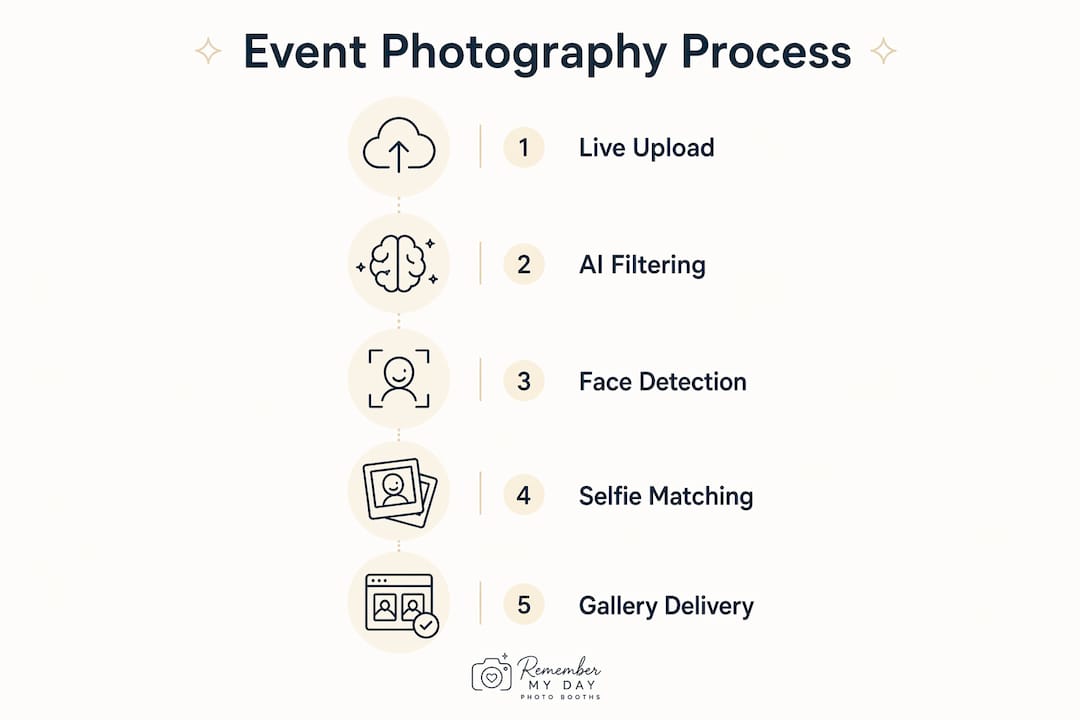
Automated event photography is the industry term for AI-driven, cloud-based photo capture and delivery workflows. The core process has five stages, each powered by a different layer of technology.
1. Live camera-to-cloud upload
Photographers shoot with cameras tethered to laptops or connected via Wi-Fi, sending images directly to a cloud server the moment the shutter fires. Live camera-to-cloud technology bypasses SD cards entirely, supporting multiple photographers simultaneously and events with more than 15,000 guests. No image sits on a memory card waiting to be downloaded.
2. AI culling and quality filtering
Once images reach the cloud, an AI model reviews every frame for sharpness, exposure, and composition. Blurry shots, closed eyes, and duplicates are filtered out automatically. This step alone saves hours of manual review after large events.
3. Face detection and embedding generation
The system scans each approved photo for faces and converts every face into a mathematical representation. Face detection and embedding generation happens in under one second per image. That speed makes real-time delivery possible even at high-volume events.
4. Guest selfie matching
Guests register by submitting a selfie via a QR code or web link when they arrive. The system converts that selfie into its own embedding and compares it against every photo in the event library. Matching takes under one second, and the guest receives a personal gallery link within 60 seconds of each new photo upload.
5. Personalized gallery delivery
Each guest sees only photos that include their face. The gallery updates automatically as new photos arrive throughout the event. Guests can download, share, or save their photos directly from the link.
Pro Tip: Set up your guest selfie registration station at the event entrance, not inside the venue. Guests who register before the event starts appear in the system from the first photo, so they never miss a moment.
Why do automated photography systems outperform manual workflows?
The advantages of automated photography go well beyond speed. They change the economics and the guest experience of event photography in ways that manual workflows simply cannot match.
- Dramatic cost reduction. Automation reduces post-event sorting and tagging effort, cutting costs by 60–85% compared to manual workflows in commercial photography settings. That saving comes from eliminating the hours photographers and editors spend reviewing thousands of frames by hand.
- Unlimited scalability. A manual editor can tag a few hundred photos before fatigue sets in. AI tagging processes all images with consistent accuracy regardless of volume. A 5,000-person gala and a 50-person dinner party receive the same quality of service.
- Faster delivery drives more sharing. Guests who receive their photos during the event are far more likely to share them on social media while the energy is still high. Real-time delivery turns every guest into a content creator for your event.
- Privacy by design. Guests who opt out of the selfie registration receive no alerts and no photos. Personalized photo access means the public gallery never exposes one guest’s image to another. That privacy model builds trust and increases opt-in rates.
- Photographers focus on creativity. Automation frees photographers from sorting and tagging, letting them spend the entire event capturing genuine moments instead of managing files.
The shift from manual to automated is not just an efficiency upgrade. It fundamentally changes what event photography can deliver to guests and organizers alike.
How does the core technology behind automated event photography work?
The technical backbone of automated event photography rests on three interconnected systems: facial recognition embeddings, similarity matching, and tunable accuracy thresholds.
Facial recognition embeddings
Facial recognition systems convert each detected face into a 512-dimensional vector, a list of 512 numbers that describes the geometry of that face mathematically. No actual photo is stored for comparison. Only the numbers are retained. This approach eases privacy concerns because the raw image is never used again after the embedding is created.
Cosine similarity matching
When a guest submits a selfie, the system generates a 512-dimensional embedding for that selfie too. It then compares that embedding against every face embedding in the event library using cosine similarity, a mathematical formula that measures how closely two vectors point in the same direction. A score close to 1.0 means the faces are almost certainly the same person. A score near 0 means they are different people. This comparison happens in milliseconds.
Tunable thresholds and background re-matching
Accuracy is tunable via cosine similarity thresholds, which means event organizers and system operators can adjust how strict the matching needs to be. A lower threshold catches more matches but risks including photos of people who look similar. A higher threshold is more precise but may miss some valid matches. Professional systems also run background re-matching, retrying face recognition on images taken in low light or with partially obscured faces, improving results without any manual intervention.
Upload speed as the real bottleneck
The AI processing is fast. The upload is often where delays happen. Tethered shooting and live-to-cloud hardware are the standard solution, connecting cameras directly to laptops or dedicated upload devices that push images to the cloud the moment they are captured. A strong, dedicated Wi-Fi network at the venue is not optional. It is the foundation the entire system depends on.
Pro Tip: Ask your venue for a dedicated network connection for your photography team. Shared guest Wi-Fi is almost always too congested for reliable real-time uploads at large events.
What are the best practices for event organizers using automated photography?
Adopting automated photography systems works best when organizers treat setup as part of the event plan, not an afterthought.
- Build selfie registration into the arrival flow. Place QR code stations at check-in so guests register before they enter the main space. Early registration means guests appear in the system from the first photo of the night.
- Communicate the experience in advance. Send guests a short note before the event explaining how the photo system works and what to expect. Guests who understand the process opt in at higher rates and engage more enthusiastically.
- Confirm your network infrastructure early. Upload speed from camera to cloud is the most common bottleneck in real-time delivery. Walk the venue with your photography team at least one week before the event to test connectivity in every shooting location.
- Set your matching threshold to match your event type. A corporate conference with name badges and formal attire benefits from a higher threshold. A costume party or outdoor festival with varied lighting may need a lower threshold and more aggressive re-matching.
- Protect guest privacy with clear opt-in language. Guests who skip registration receive no photos and no notifications. Make that choice visible and easy. Clear opt-in language builds the trust that makes guests comfortable sharing their selfies in the first place.
- Let your photographers shoot freely. Once the system is running, your photography team does not need to manage file transfers or labeling. Creative event photography improves when photographers focus entirely on capturing genuine moments.
The organizers who get the most from automated photography are the ones who plan the technology setup with the same care they give to catering and decor.
Key Takeaways
Automated event photography delivers personalized photo galleries to guests in real time by combining AI facial recognition, cloud uploads, and cosine similarity matching to replace slow, expensive manual workflows.
| Point | Details |
|---|---|
| Real-time delivery | AI matches guest faces and delivers personal galleries within 60 seconds of each photo upload. |
| Cost efficiency | Automation cuts post-event sorting and tagging costs by 60–85% compared to manual workflows. |
| Privacy by design | Guests see only photos featuring their own face, and opt-out guests receive no images or alerts. |
| Upload speed matters | Tethered cameras and a dedicated venue network are the foundation of reliable real-time delivery. |
| Photographers gain creative freedom | Automated sorting and tagging free photographers to focus entirely on capturing memorable moments. |
What we have learned from watching automation change event photography
We have been part of hundreds of events in San Antonio, and the shift toward automated photography systems is one of the most meaningful changes we have seen in this industry. Not because it replaces photographers. It does not. But because it changes what photographers can do with their time and attention.
The events where guests feel most connected are the ones where something surprising happens. Getting a personal photo gallery on your phone while you are still on the dance floor is genuinely surprising. It sparks conversations. It gets shared. It makes the event feel alive in a way that a download link sent three weeks later never could.
We also believe the privacy piece is underrated. Guests are more comfortable participating when they know the system is built around their consent. Opt-in selfie registration is not just a legal consideration. It is a hospitality decision. Guests who trust the system engage with it more, and that engagement shows up in the photos.
The technology will keep improving. Matching accuracy in difficult lighting conditions is getting better every year. Integration with event apps and digital check-in systems is becoming standard. For event organizers who want to stay ahead, the time to get familiar with AI-powered photo booth experiences is now, not after your competitors have already made it a guest expectation.
— RMD
Bring automated photo experiences to your next event with Rmdphotobooths
Rmdphotobooths brings the excitement of automated and AI-powered photography to events across San Antonio, with over 1,000 five-star reviews and experience across weddings, corporate gatherings, and large celebrations.

From 360° booths to AI-powered watercolor portraits and robot photo booths, our full range of experiences puts the best of event photography technology directly into your guests’ hands. Every setup is designed to create those “wow” moments your guests will treasure forever. Ready to make your next event truly shine? Book your experience today and let us handle the magic.
FAQ
What is automated event photography?
Automated event photography is an AI-driven system that uses facial recognition and cloud-based workflows to capture, process, and deliver personalized photo galleries to event attendees in real time, typically within 60 seconds of each photo upload.
How does facial recognition work in event photography?
The system converts each detected face into a 512-dimensional mathematical vector and uses cosine similarity to match guest selfies against event photos, completing the comparison in under one second without storing actual facial images.
What are the main advantages of automated photography for large events?
Automated photography scales without limits, cuts post-event sorting costs by 60–85%, and delivers photos to guests during the event rather than days later, increasing social sharing and guest satisfaction.
How do event organizers protect guest privacy with automated systems?
Guests opt in by submitting a selfie at registration and receive only photos featuring their own face. Guests who decline to register receive no photos and no notifications, keeping their presence in the event gallery private.
What is the biggest technical challenge in real-time event photo delivery?
Upload speed from camera to cloud is the most common bottleneck. Tethered cameras connected to dedicated upload hardware, combined with a private venue Wi-Fi network, are the standard solution for maintaining sub-60-second delivery at large events.