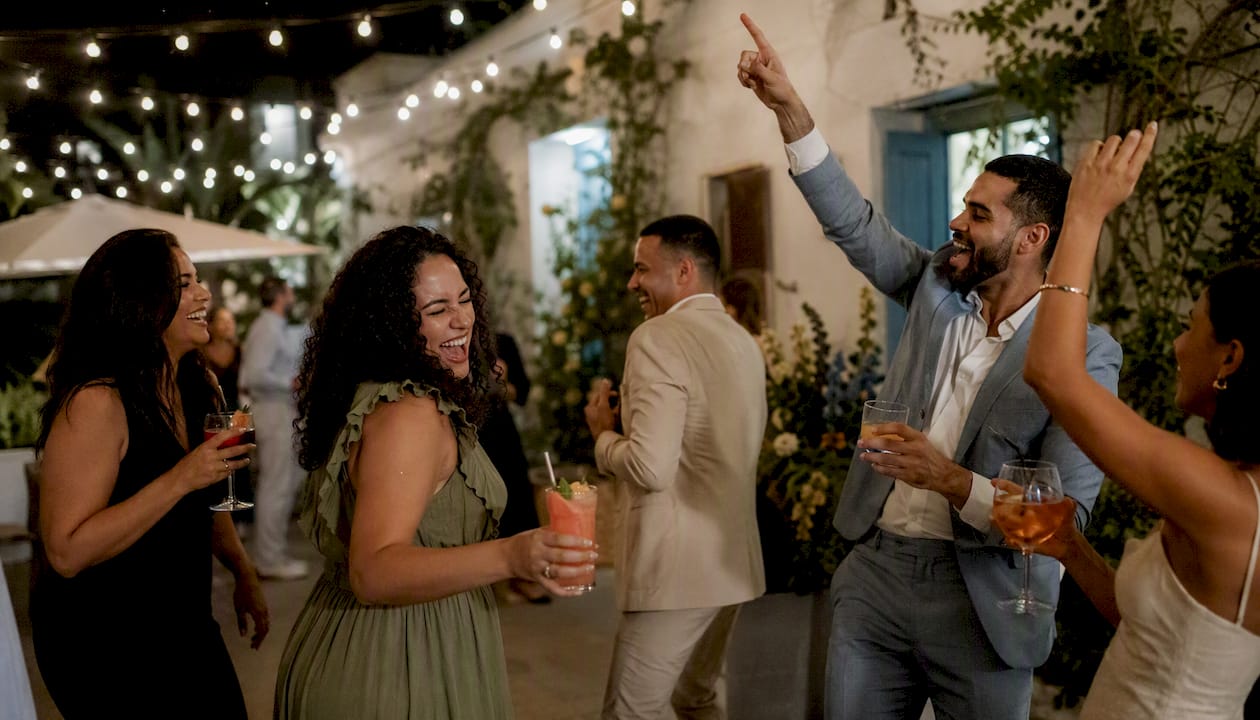
An immersive event activation is a designed experience that pulls attendees into a story-driven environment where every sensory layer, interactive touchpoint, and spatial element works together to create genuine participation and lasting memory. Three elements define it:
- Sensory layering: lighting, sound, scent, and texture working as one environment
- Narrative structure: a story arc that gives the experience a beginning, middle, and end
- Interactive agency: attendees make choices, not just observations
Remo’s event design blog puts it plainly: tech alone doesn’t make an activation immersive. Story, space, and interaction do. Rmdphotobooths brings that principle to life at San Antonio events with immersive booth experiences that fit neatly into any activation journey.
Pro Tip: Write your one-sentence activation definition before you book a single vendor. If you can’t describe what attendees will feel and do, the design hasn’t started yet.
Key Takeaways
Immersive event activations succeed when story, space, and interaction are designed together from the start, not assembled after the tech is chosen.
| Point | Details |
|---|---|
| Definition first | An immersive activation combines sensory layering, narrative structure, and interactive agency. |
| Narrative before tech | Write the guest arc before briefing any vendor; tech serves the story, not the reverse. |
| Plan measurement early | Define KPIs like dwell time, interaction rate, and social share rate before the creative brief is written. |
| Flow design matters | Zone your space into entry, discovery, climax, reflective pause, and exit to preserve narrative momentum. |
| Rmdphotobooths as touchpoint | Rmdphotobooths’s 360° booths, roaming activations, and AI portrait stations serve as measurable, shareable climax-zone moments for San Antonio events. |
Table of Contents
- What makes an activation genuinely immersive?
- When does an immersive activation fit your event?
- How do you plan an immersive activation step by step?
- Physical, virtual, or hybrid: which venue format fits?
- What technology options fit your budget and narrative?
- Which interactive touchpoints will attendees actually use?
- What operations, staffing, and accessibility do you need?
- How do you measure whether the activation worked?
- What are the most common pitfalls and how do you avoid them?
- How Rmdphotobooths fits into a real immersive activation
- The one thing that actually determines whether immersion works
- Rmdphotobooths brings immersive activations to life in San Antonio
- Sources
What makes an activation genuinely immersive?
Four markers separate a real immersive experience from a visually interesting backdrop.
Sensory layering means every channel reinforces the same theme. At the Van Gogh immersive exhibitions, floor-to-ceiling projection, spatial audio, and ambient scent all carried the same painterly world. Remove one layer and the illusion weakens. RBKAVIN Immersive Studio frames it well: if the experience disappears when a visitor turns around, it isn’t truly immersive. The environment must be the content.
Narrative structure gives attendees a reason to move through the space. Arch Meetings and Events identifies setting, arc, conflict, and resolution as the scaffolding that turns individual touchpoints into a cohesive guest journey. Adobe MAX uses this well: each zone builds on the last, so attendees feel they’re progressing through a story rather than browsing a trade show.
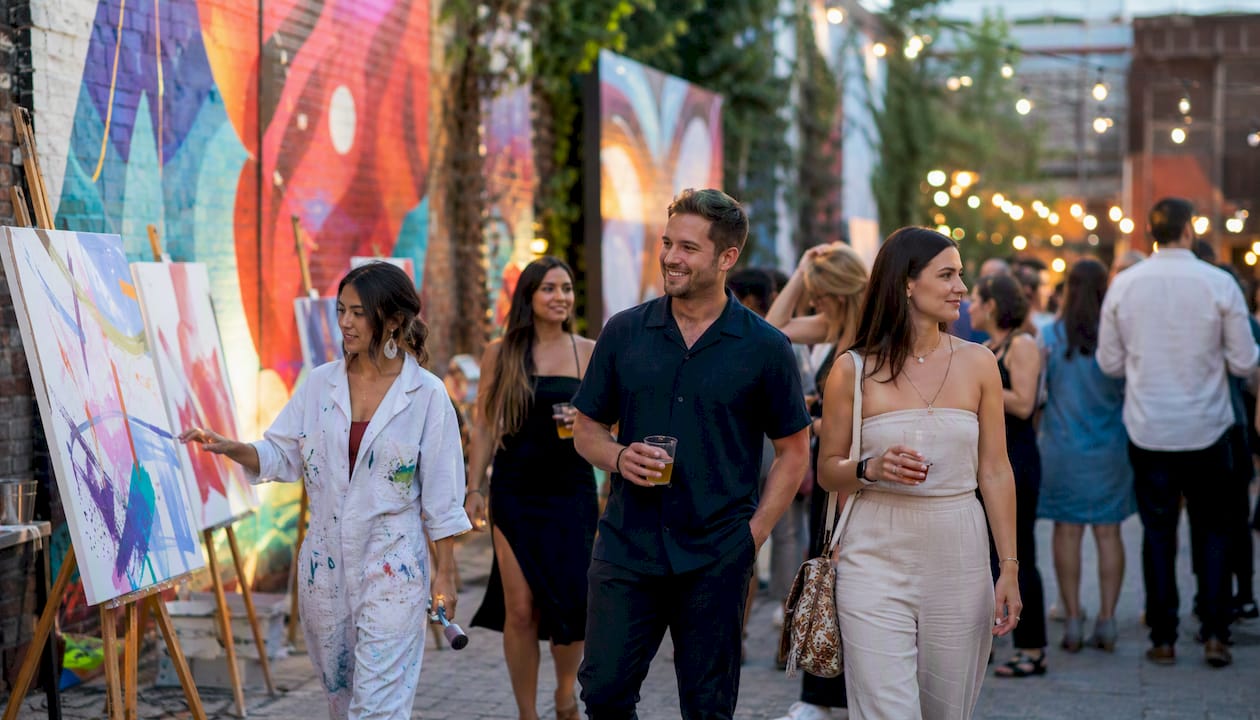
Interactive agency means attendees make real choices. A live poll, a gamified quest, or a 360° photo booth moment all give guests something to do, not just observe. That participation is what creates emotional memory.
Purposeful tech is the fourth marker. DesignScene’s critique of misused “immersive” labels is direct: participation and worldbuilding are required. Projection on a wall without a story is spectacle, not immersion.
Quick definition checklist for your brief:
- Does every sensory element reinforce one narrative?
- Can attendees influence or contribute to the experience?
- Does the tech serve the story, or is it the story?
- Does the environment hold up from every angle?
When does an immersive activation fit your event?
Immersion earns its budget when the objective requires emotional connection, not just information transfer. Common fits:
- Product launches where the product benefit needs to be felt, not explained
- Brand positioning campaigns that need to shift perception, not just awareness
- VIP and loyalty events where exclusivity and memory are the deliverable
- Internal training where retention matters more than attendance numbers
- Festival and pop-up activations where standing out in a crowded environment is the goal
ImmerseForge’s brand experience guide adds a useful filter: activations should add utility to the attendee experience, not interrupt it. A festival booth that provides shade and charging stations wrapped in brand storytelling earns attention. One that demands attention without giving anything back loses it.
Effort levels by format:
- Retail pop-up or brand activation (low-medium effort): QR-triggered AR, branded photo booth, ambient sound
- Conference or summit (medium effort): projection mapping, spatial audio zones, gamified app features
- Festival activation (medium-high effort): multi-zone narrative environment, live performers, 360° capture
- Hybrid product launch (high effort): XR stage, synchronized virtual and physical environments, real-time social amplification
How do you plan an immersive activation step by step?
Follow this workflow from goal to opening night.
- Write a goal statement. One sentence: what should attendees feel, do, and remember?
- Draft a narrative brief. Define the setting, the arc, and the moment of peak participation.
- Select and survey the venue. Map power sources, sightlines, ceiling height, and ADA pathways.
- Design the environment. Assign sensory roles: which zones carry lighting, sound, scent, texture.
- Specify the tech stack. Match each tech element to a narrative purpose. Cut anything that doesn’t serve the story.
- Plan interactive touchpoints. Identify at least three moments where attendees make a choice or create something.
- Build the staffing plan. Assign roles before the run-of-show exists.
- Schedule rehearsals and QA. Tech dry run, ADA walkthrough, guest-flow rehearsal.
- Define measurement from day one. Decide which KPIs you’ll capture before you finalize creative.
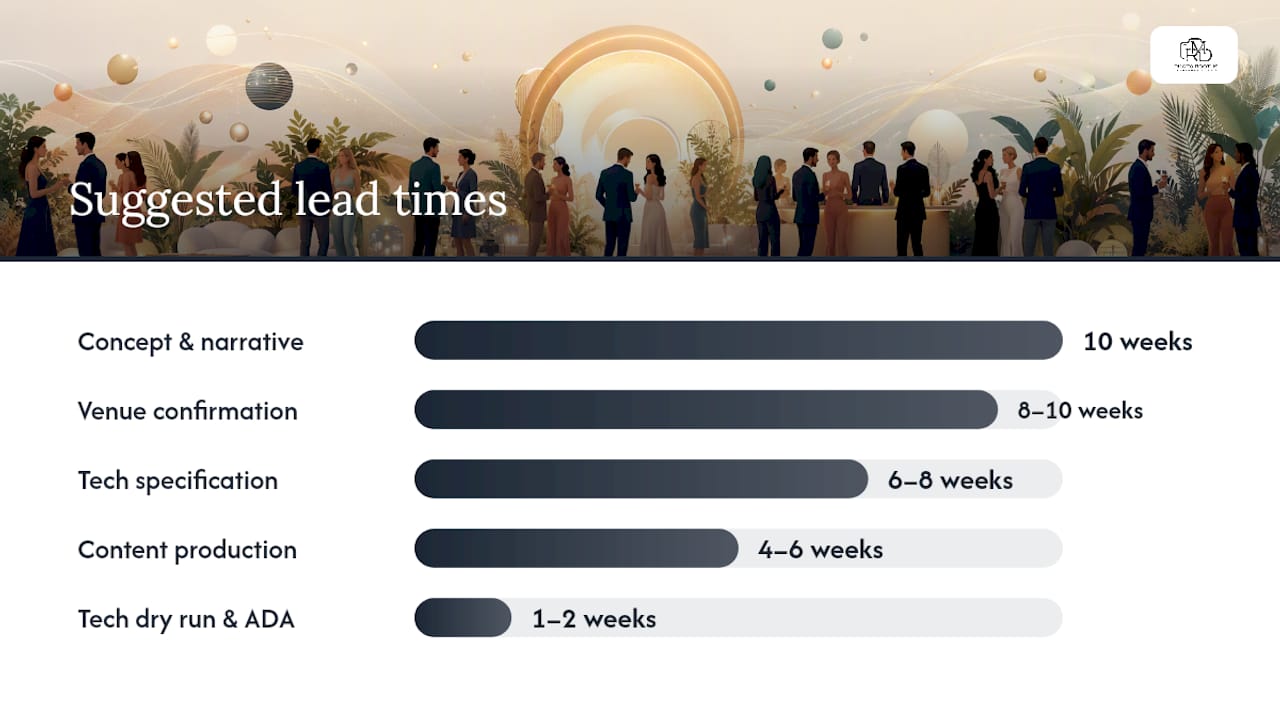
Suggested lead times:
| Phase | Suggested Lead Time |
|---|---|
| Concept and narrative brief | 10 weeks out |
| Venue confirmation and site survey | 8–10 weeks out |
| Tech specification and vendor contracts | 6–8 weeks out |
| Content production and build | 4–6 weeks out |
| Tech dry run and ADA walkthrough | 1–2 weeks out |
| Guest-flow rehearsal | 3–5 days out |
Key budget drivers: venue size and exclusivity, custom set fabrication, projection mapping content production, AV infrastructure, staffing hours, and event insurance. Measurement tools (beacons, QR analytics, survey platforms) are often underbudgeted but cost relatively little compared to the build.
Pro Tip: Lock your measurement plan before you finalize the creative. If you can’t capture a KPI in the space as designed, redesign the space, not the KPI.
Physical, virtual, or hybrid: which venue format fits?
| Factor | Physical | Virtual | Hybrid |
|---|---|---|---|
| Sensory depth | Highest | Limited to screen/audio | Partial for remote |
| Infrastructure needs | AV, power, set build | Platform, bandwidth | Both, plus sync layer |
| Accessibility | ADA design required | Broadest reach | Complex to equalize |
| Cost range | Highest | Lowest | Mid-to-high |
| Social amplification | Strong with photo capture | Built-in sharing tools | Strong with both |
Venue layout directly shapes how immersive programming lands with attendees. Design your flow in five zones: entry (orient and prime), discovery (introduce the narrative), climax (peak participation moment), reflective pause (let the experience land), and exit (branded takeaway or social share).
For projection mapping and large installations, maintain clear sightlines of at least 15 feet from the projection surface to the primary viewing area. Crowding thresholds matter: a zone designed for 50 guests at a time loses its atmosphere at 80.
What technology options fit your budget and narrative?
Low-effort tier: QR-triggered AR overlays, event app features (live polls, scavenger hunts), branded digital photo outputs. These require minimal infrastructure and can be deployed in hours.
Medium-effort tier: Projection mapping on architectural surfaces, spatial audio zones, AR portals with world-tracking. These need advance content production and dedicated AV support.
High-effort tier: Full VR simulations, XR stages, world-tracked AR with real-time rendering. These require specialist vendors, significant lead time, and robust network infrastructure.
Pro Tip: Always build a fallback. If your projection mapping fails, what runs instead? A pre-rendered loop on a screen is better than a blank wall. Brief your tech team on the fallback before load-in.
For U.S. events, photo and video capture at activations requires clear onsite signage informing attendees that photography is in use. Offer an opt-out workflow for sensitive environments, and confirm your data retention policy with your legal team before the event.
Which interactive touchpoints will attendees actually use?
Cvent’s experiential event research shows that mobile apps and AR increase both interactivity and social amplification, while gamification and hands-on labs drive dwell time and measurable outcomes. The formats that consistently perform:
- Gamified quests with badge systems or leaderboards
- Live workshops and hands-on labs tied to the brand narrative
- Sensory bars (taste, scent, or texture stations that reinforce the theme)
- 360° video booths and roaming photo activations
- Live performers who respond to attendee choices
- AR overlays triggered by physical markers in the space
A chained sequence that works well: arrival AR trigger at the entrance → guided discovery zone with a narrative prompt → participatory installation where guests contribute something → branded photo output as the exit moment. Each step builds on the last and creates a shareable artifact.
A photo booth placed at the exit of a climax zone captures attendees at peak emotional engagement. That’s when the photo means something, and that’s when it gets shared. The booth isn’t a decoration. It’s the measurement point and the social amplifier in one.
Rmdphotobooths’s interactive photography options fit precisely into this sequence. A 360° booth at the climax zone, a roaming booth in the discovery area, or an AI watercolor portrait station at the reflective pause all serve the narrative while generating shareable content and session-count data.
Pro Tip: Give every touchpoint a job in the narrative arc. If you can’t explain why a touchpoint is where it is in the story, move it or cut it.
What operations, staffing, and accessibility do you need?
Core roles for a mid-scale immersive activation:
- Producer (overall delivery and vendor coordination)
- Technical lead (AV, projection, network)
- Stage manager (run-of-show and timing)
- Experience hosts (2–4 per 200 attendees, guiding the narrative)
- Content operator (live content switching and tech monitoring)
- Photography lead (booth staffing and output quality)
- Security and crowd management
- On-site AV tech (dedicated to troubleshooting)
Safety and accessibility checklist:
- Fire code compliance for all set materials and projection equipment
- Tech failover systems tested before doors open
- Clear sightlines and unobstructed pathways for wheelchair access
- Tactile cues at zone transitions for low-vision attendees
- Captioning or transcripts for all AV content
- Crowd density monitoring at peak zones
For U.S. events, post clear signage at all photography zones stating that images may be captured and used. Provide a simple opt-out process, and retain only the data your privacy policy covers.
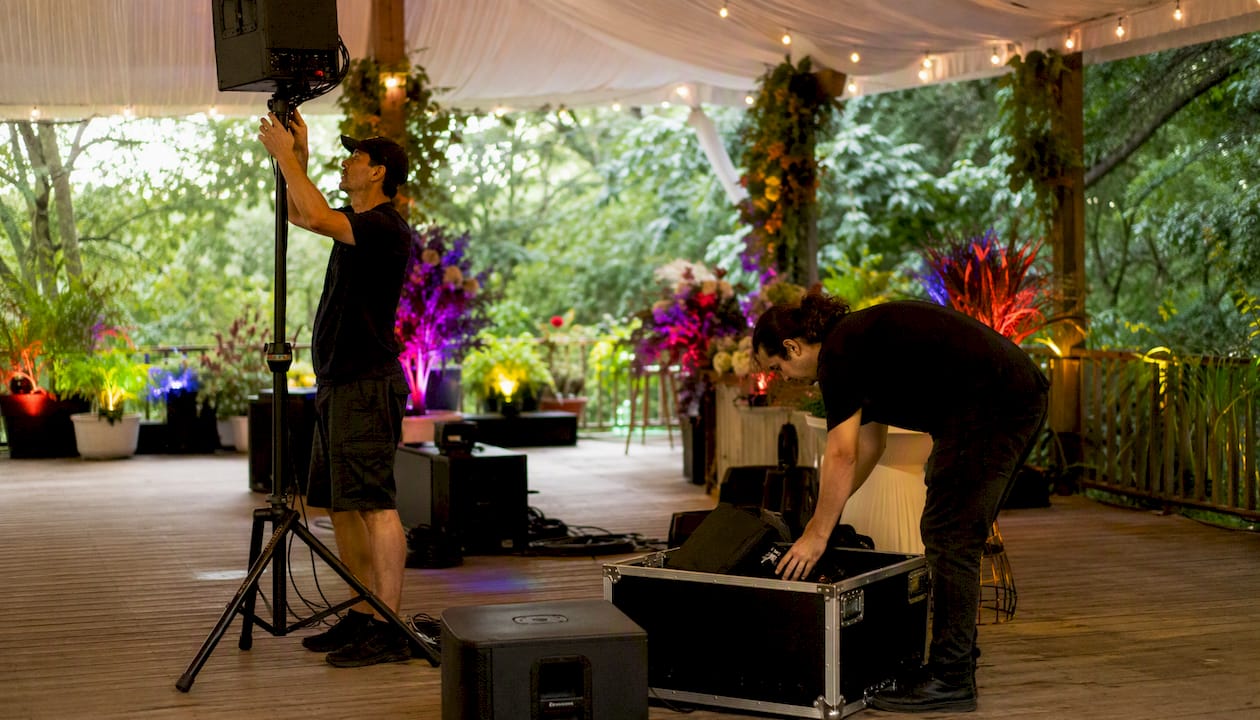
Integrating entertainment partners into your staffing plan early reduces day-of coordination friction significantly.
How do you measure whether the activation worked?
KPIs worth tracking:
- Dwell time per zone (beacon or Wi-Fi analytics)
- Interaction rate (QR/AR scan counts, booth session counts, app engagement)
- NPS or CSAT (post-event survey, ideally same-day)
- Social impressions and earned media (social listening tools like Sprout Social or Brandwatch)
- Lead conversion (badge scans, form completions at touchpoints)
- Repeat engagement (return visits to a zone, multi-session booth use)
Capture methods by touchpoint:
| Touchpoint | Capture Method | What It Measures |
|---|---|---|
| AR overlay | Scan count via QR analytics | Interaction rate |
| Photo booth | Session count and share rate | Engagement and social reach |
| Gamified quest | App completion data | Dwell time and participation depth |
| Exit survey | NPS platform (e.g., SurveyMonkey) | Sentiment and recall |
| Zone dwell | Beacon or Wi-Fi analytics | Flow and crowding patterns |
Set conservative targets before the event. A well-designed activation at a corporate event might realistically target a high interaction rate at a primary touchpoint and a substantial social share rate from photo outputs.
What are the most common pitfalls and how do you avoid them?
- No narrative cohesion. Tech and décor without a story arc feel like a trade show, not an experience. Fix: storyboard the full guest arc before any vendor is briefed.
- Tech overreach. Adding VR because it’s impressive, not because it serves the story. Fix: for every tech element, ask “what does this make the attendee feel or do?” If the answer is vague, cut it.
- Poor guest flow. Bottlenecks at peak zones destroy immersion faster than any tech failure. Fix: run a timed guest-flow rehearsal with staff playing attendees.
- No measurable objectives. “We want people to feel inspired” is not a KPI. Fix: define at least two quantitative targets before the creative brief is written.
Pro Tip: Your most expensive mistake is usually a tech element that fails on the day and has no fallback. Budget for redundancy before you budget for spectacle.
How Rmdphotobooths fits into a real immersive activation
Rmdphotobooths serves San Antonio event planners with a range of photo booth experiences that map directly to immersive touchpoint roles. 360° video booths for climax-zone capture, roaming booths for discovery-zone engagement, AI watercolor portrait stations for reflective-pause moments, and Glambot cinematic booths for high-production brand activations.
Operational integration tips:
- Place the 360° booth at the activation’s peak emotional moment, not the entrance
- Confirm power requirements (typically 15–20 amps) and floor space (10×10 feet minimum) during the site survey
- Use branded overlays and custom print templates to keep every output on-narrative
- Brief the booth attendant as an experience host, not just a tech operator
With over 1,000 five-star reviews and experience across weddings, corporate events, and large-scale galas, Rmdphotobooths brings the operational reliability that immersive activations demand. Every session is a data point, a social asset, and a memory made tangible.
Booking is straightforward through the Rmdphotobooths platform, and the team provides on-site support throughout the event.
The one thing that actually determines whether immersion works
Most planners over-invest in technology and under-invest in narrative. We’ve seen activations with six-figure AV budgets fall flat because attendees had nothing to do inside them, and we’ve seen a single well-placed photo booth with a strong story prompt generate more social reach than a full projection-mapped room.
The practical implication: in every vendor brief and every internal buy-in conversation, insist on a written narrative arc before any tech is specified. If a vendor can’t tell you what the attendee will feel at the climax moment, they’re selling you equipment, not an experience. That’s the question worth asking first, every time.
Rmdphotobooths brings immersive activations to life in San Antonio
Planning an immersive activation in San Antonio? Rmdphotobooths gives you a photo experience partner with the range, reliability, and on-site expertise to make every touchpoint count. From 360° video booths to AI-powered portrait stations, our team handles setup, staffing, and branded output so you can focus on the guest journey.
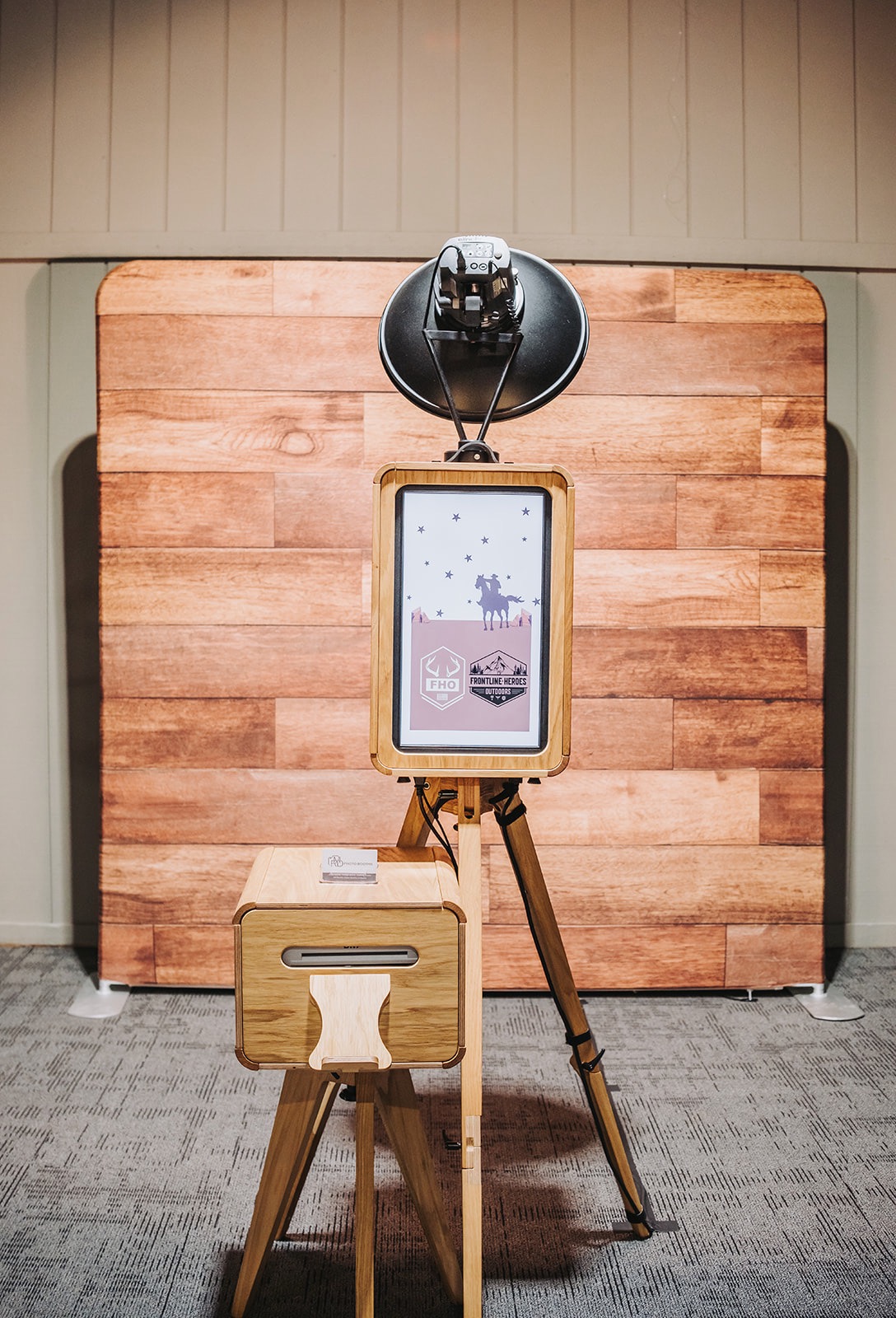
With 1,000+ five-star reviews and experience across corporate events, galas, and brand activations, we know how to fit a photo activation into your narrative arc without missing a beat. Check availability and book your experience today, or browse our full range of photo booth experiences to find the right fit for your event.
Sources
- What is an immersive event — Remo blog
- Experiential event ideas — Cvent
- Brand immersive installations | RBKAVIN. Immersive Studio
- How to create immersive event experiences — Arch Meetings and Events
- The Complete Guide to Immersive Brand Experiences in 2026 | ImmerseForge
- Please Stop Calling Your Event ‘Immersive’—It’s Not – DesignScene