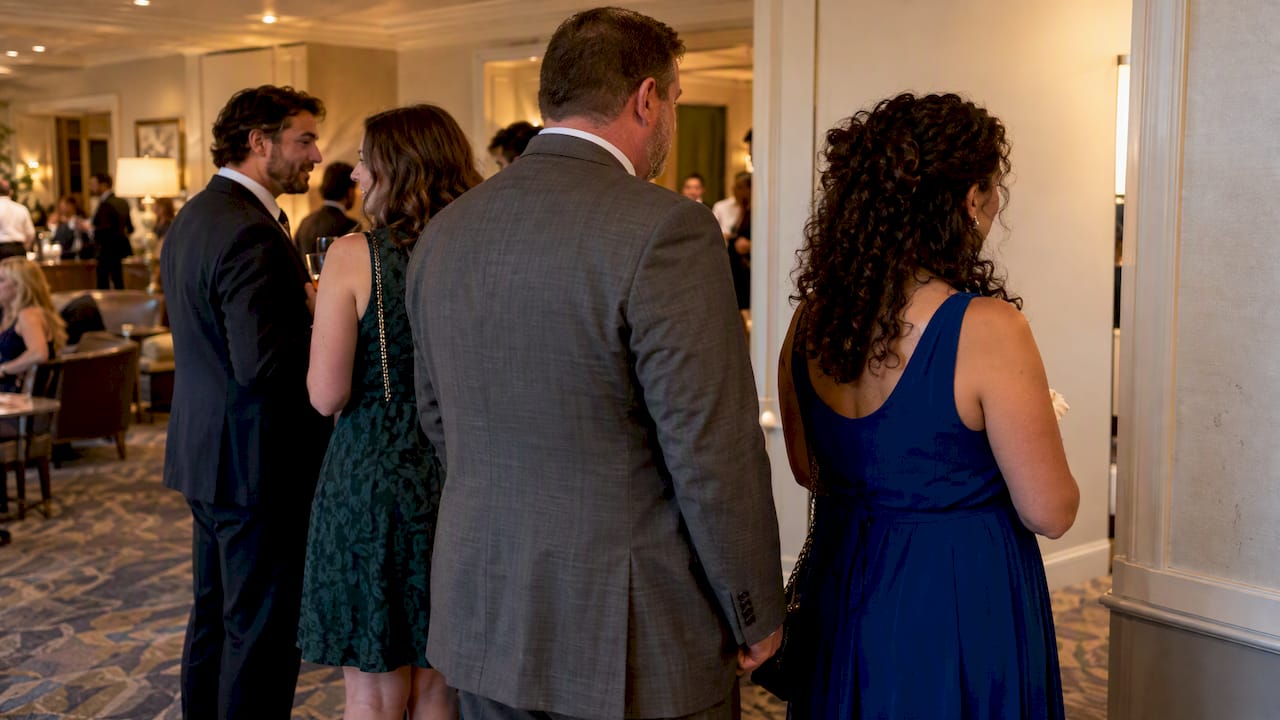
A photo booth line is a good problem. It means your guests want in. But a line that snakes past the bar and stalls the dance floor is a problem, and you can fix it before the event starts. Good photo booth queue management comes down to five things: realistic capacity math, a booth placed with room for a line, a dedicated line host, a short and repeatable session, and something fun for guests to do while they wait.
We’re RMD Photo Booths, and we’ve worked with San Antonio hosts, planners and venue teams on weddings, galas and corporate events. Here’s how we’d plan a line that feels like part of the party.
TL;DR
- Do the capacity math first: one booth can only finish so many sessions an hour, so match the booth count and session length to your guest count.
- Use a hybrid line: a small visible line at the booth, plus a QR code or text sign-up for overflow at larger events.
- Give the line to someone who isn’t running the equipment. A dedicated line host can lift throughput by 30% to 40%.
- Give waiting guests something to do, and tell them where they stand. Perceived wait matters more than the clock.
- Choose a booth that fits your crowd: roaming and selfie-style booths handle volume, while 360 and glam booths are showpieces that need pacing.
Table of Contents
- Start With Capacity, Not Hope
- Place the Booth So a Line Can Form Gracefully
- Build a Hybrid Line for Bigger Crowds
- Put a Line Host in Charge
- Make the Session Short and Repeatable
- Make the Wait Feel Shorter
- Our Perspective: A Line Is a Sign You Chose Well
- Choose the Booth That Fits Your Crowd
- Plan Your Event’s Line With Us
- A Quick Event-Day Checklist
- FAQ
- Sources
Start With Capacity, Not Hope
Most lines are born at the planning stage. A host books one booth for 200 guests, everyone heads over during cocktail hour, and the math simply doesn’t work.
Be skeptical of big capacity claims. One corporate planning guide points out that a vendor-reported three-minute headshot session sounds brief, yet one booth could finish only 20 such sessions in an uninterrupted hour, and that figure came from the vendor rather than an independent test. Another event-photography guide advises asking vendors for the tested assumptions behind capacity estimates, including staffing, print speed and digital sharing steps, and how they hold up when a crowd surges at a break.
Here’s a simple way to run your own numbers:
- Estimate real session time. Include walking up, picking a prop or a screen option, posing, the countdown, and stepping out. A group strip takes longer than a solo shot.
- Divide 60 by that number. A 3-minute turnover is about 20 groups an hour. A 90-second turnover is about 40.
- Multiply by group size. If your average group is three people, 20 sessions serve about 60 guests an hour.
- Compare with the window. If 150 guests all want a turn in a 60-minute cocktail hour, you need either a longer rental, a faster booth or a second experience.
Not every guest will queue. At many weddings, a good share will pass or join late in the night. But plan for the busiest 30 minutes, not the average.
Place the Booth So a Line Can Form Gracefully
Where you put the booth decides how the line looks. One event-booth guide recommends putting it where guests already gather, such as near the bar, the dance floor or the cocktail space, so guests find it easily and the line forms in an orderly, visible way. The same guide suggests leaving at least eight to ten feet of room for the queue to breathe.
A few venue-specific tips we’d pass along:
- Keep it out of doorways and the path to restrooms. A line that blocks traffic annoys everyone, including people who never wanted a photo.
- Don’t hide it in a corner. Out of sight means the line can’t show a little social proof and guests may miss the booth.
- Think about sound and light. A booth right next to the speakers makes it hard for guests to hear the host’s instructions.
- Walk the space with your coordinator. Our photo booth setup process guide covers what to check before the booth arrives, from power to floor space.
Venue managers: if you have a preferred spot with outlets and room for a line, send it to the host early. It saves everybody a scramble on event day.
Build a Hybrid Line for Bigger Crowds
For a 75-person dinner, a simple stand-in line is plenty. For a gala, conference or brand activation, a stand-in line alone can turn into a wall of people.
Event-capacity research recommends a hybrid approach: a small, visible standby line plus a virtual queue for overflow. Guests join by QR code or text, get updates as they move up, and can go enjoy the party in the meantime. That same source reports a 37.4% increase in attendees served per hour at Marvel’s San Diego Comic-Con 2025 photo activation. That is a huge event and a different scale from most weddings, but the principle carries over.
Here’s how to scale it down:
| Event size | Simple approach |
|---|---|
| Under 100 guests | One booth, a short stand-in line, a friendly line host |
| 100 to 250 guests | Two experiences (for example a traditional booth plus a roaming option) so lines split naturally |
| 250+ guests or timed corporate activations | Hybrid: visible line, plus a QR or text sign-up, plus a second booth |
For most weddings you don’t need software. A clipboard, a stack of numbered cards or a handwritten “next up” list works. What matters is that guests know they have a spot.
Put a Line Host in Charge
The biggest single fix is also the cheapest: don’t make the booth operator manage both the equipment and the crowd. The Edin Studios guide says a dedicated queue coordinator can improve total station throughput by 30% to 40% compared with setups where the operator does both. That figure comes from a corporate headshot context, so treat it as a guide rather than a promise for a wedding.
The host’s job is simple:
- Greet the next group and explain how it works in one sentence.
- Hand out props or explain the touchscreen while the current group finishes.
- Keep groups to the size the booth handles comfortably.
- Politely move along groups who want a fifth retake.
- At corporate events, collect any needed sign-ups, answer questions, and keep branding moments on track.
At a wedding, this can be a bridesmaid, a friend with a big smile, or a coordinator. At a corporate event, it’s usually a brand ambassador or a staff member. Tell them ahead of time, so nobody is asked at the last minute.
If you want to help guests behave well in line and inside the booth, share our photo booth etiquette guide for guests. It covers posing, sharing and respecting the space.
Make the Session Short and Repeatable
A smooth line is mostly a fast, predictable session. You can tune these dials ahead of time:
- Number of photos. Fewer frames means a shorter session. A three-shot layout is quicker than a six-shot one.
- Retakes. Decide whether guests get one retake or none.
- Prints versus digital. Prints are a joy, but print speed can bottleneck a line if the guest waits for them. Our guide on photo booth rental turnaround time for prints explains what to expect.
- Instructions on screen. A clear welcome screen cuts down questions and false starts.
- Custom layouts. Choosing the design in advance means no one is deciding at the booth. Browse our design templates or read our guide to customizing the photo booth experience.
For private parties, our photo booth workflow guide walks through the flow from start to finish.
Make the Wait Feel Shorter
The psychology matters as much as the math. Research on virtual queues finds that customers judge waiting by perception, which is often longer than the actual time, so managing perceived wait is key. Updates about position and the estimated wait help, and so does giving guests something meaningful to do while they wait.
A separate study in Service Science compared ticket queues with physical queues and found that guests were more patient in ticket queues. Simply knowing your turn is coming changes how a wait feels.
Practical ways to put that into play:
- Say how long it will be. A host who says “about five minutes” beats a blank stare. Be honest and err slightly long.
- Put a preview screen or a gallery in view. Guests see how fun the results are and get ideas for their own pose.
- Set up a prop table in line. Guests can plan their shots before they reach the front.
- Add a simple activity. A list of party game ideas for adult guests can inspire a quick icebreaker for a corporate mixer or a long cocktail hour.
- Keep the line near the action. Music, drinks and conversation are the best entertainment, so don’t push the line into a quiet hallway.
Our Perspective: A Line Is a Sign You Chose Well
We’ve executed more than 5,000 events, and the pattern is consistent: the hosts who are happiest with their booth aren’t the ones who never had a line. They’re the ones who planned for it.
We look at queue management as part of the experience, not a chore after it. A guest who gets a friendly greeting, a clear idea of how long the wait is, and a fun moment at the front will remember the booth, not the line. A guest who stands for 25 minutes with no information will remember that instead.
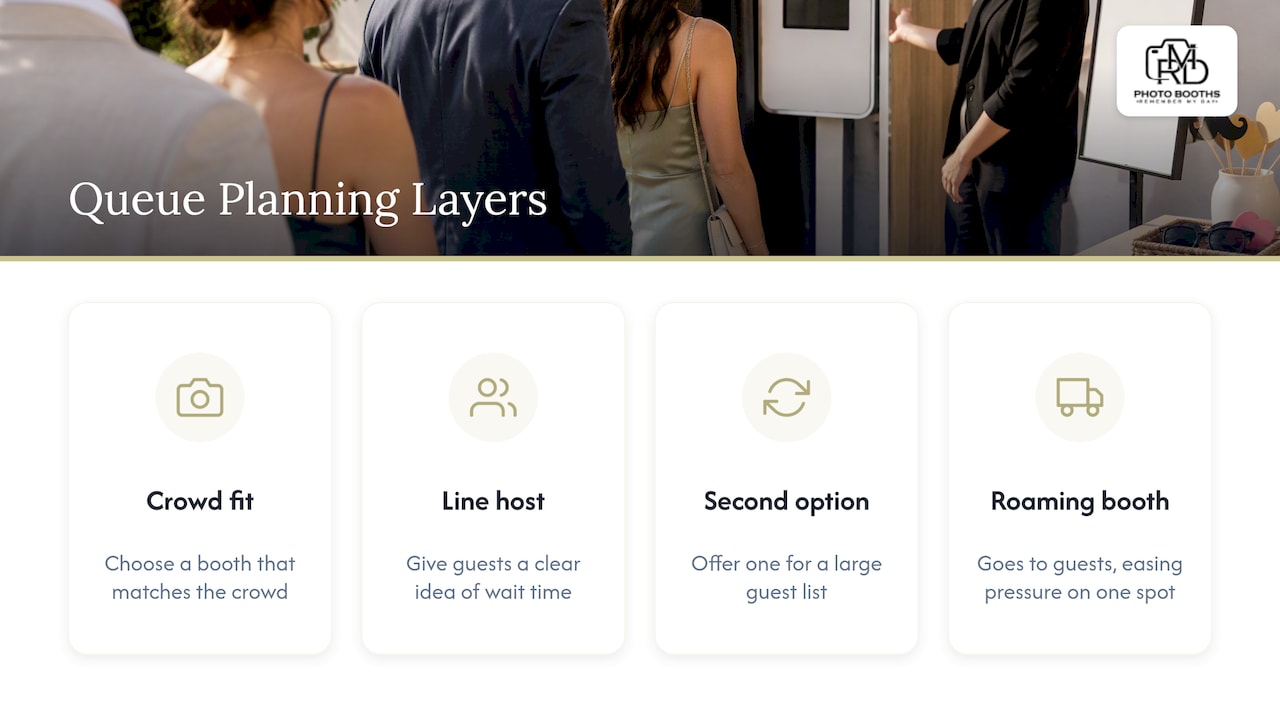
So we encourage our clients to think in layers. Pick a booth that matches the crowd. Give the line a host. Offer a second experience when the guest list is large, so people can choose what suits them. A roaming booth, for instance, goes to guests rather than asking guests to come to it, which takes pressure off a single spot. And our exclusive options, including the only roaming robot photo booth in South Texas, give guests something to watch and talk about while others take their turn.
Most of all, talk to us early. Tell us your guest count, your timeline, your venue layout and when you expect the rush. We’ll help you shape a plan that keeps the energy high and the line moving.
— RMD
Choose the Booth That Fits Your Crowd
Different booths create different lines. Here’s how we think about it, with our published starting prices for a one-time event rental:
| Booth | Starting price | Line behavior |
|---|---|---|
| Selfie Booth | from $625 | Quick, casual sessions that suit steady traffic |
| Roaming Booth | from $650 | Goes to guests, so there’s no single line |
| Traditional Booth | from $900 | Classic group sessions, good for weddings and parties |
| Glam Booth | from $1,000 | Polished, takes a little longer per guest |
| 360 Booth | from $1,295 | A crowd-pleaser that draws spectators, best with pacing |
| Robot Booth | from $1,395 | A showpiece that guests love to watch |
Prices vary with booth type, event duration and enhancements, so use these as a starting point. You can see the full lineup on our experiences page. If you’re weighing a spinning-platform setup against a classic enclosure, our comparison of 360 photo booths and traditional booths covers space and cost.
Plan Your Event’s Line With Us
If you’re hosting in San Antonio and want a booth plan that handles your guest count, we’d love to help. Tell us about your event, and we’ll suggest a booth, a rental length and a setup that fit. Ready to go? Book your photo booth here, or look through our gallery to see what your guests could be posing for.
A Quick Event-Day Checklist
- Confirm the booth spot and the room for a line at the venue walkthrough.
- Assign a line host and brief them on session length and group size.
- Decide on retakes, prints and layouts before the event.
- Set a prop table and a preview screen where the line can see them.
- Plan a backup, such as a second experience or a roaming booth, for peak moments.
- Time the rush, usually cocktail hour, after dinner or a break, and make sure your booth is up and ready beforehand.
FAQ
How long should a photo booth line be before I add a second booth?
There’s no magic number, but if guests are regularly waiting more than 10 to 15 minutes, or the line blocks traffic, it’s time to act. Do the capacity math in advance instead, and if the busiest half hour would leave a long line, add a second experience or extend the rental.
Do I need a virtual queue for a wedding?
Usually not. Most weddings do well with a short visible line and a friendly host. A virtual or text-based queue starts to make sense at galas, conferences and large corporate events where hundreds of guests want a turn in a short window.
Who should manage the line at my event?
Someone other than the booth operator. A friend, a coordinator or a staff member can greet guests, explain the booth and keep groups moving, which frees the operator to focus on the equipment and the photos.
How can I make the wait more fun?
Tell guests how long it will be, and give them something to look at or do: a preview screen, a prop table or a quick game. Good music and a spot near the bar help too. Waiting feels shorter when guests are engaged.
Sources
- Event Capacity Management Checklist for Conferences, NextMe
- Marvel NextMe Event Waitlist Case Study
- How to Run a Corporate Headshot Station for 500+ Attendees, Edin Studios
- Photo Booths for Corporate Events: A Practical Planning Guide, MemBooth
- What to Do When the Photo Booth Line Is Too Long, Epic Events Booth
- The Psychology of Virtual Queue, SSRN
- Comparisons of Perceptions and Behavior in Ticket Queues and Physical Queues, Service Science
Recommended
- Streamline Your Private Party Photo Booth Workflow
- Streamline event photo booth workflow: 5-step guide
- Photo Booth Etiquette: Making Every Snapshot Memorable
- Step by Step Event Photo Booth Planning Guide
This article was created with the assistance of automated AI content tools using publicly available information and may contain errors, omissions, or outdated information. Content is provided for general informational purposes only and does not represent an endorsement, criticism, or official statement regarding any person, business, product, or service mentioned. Business details, pricing, services, availability, and other information may change over time. If you believe any information is inac