

TL;DR:
- Technology now plays a crucial role in event photography, enhancing workflows through AI culling, instant sharing, and content authentication. These tools enable faster delivery, better attendee experiences, and trustworthiness in image integrity, greatly benefiting organizers and photographers alike. Successful adoption requires hybrid workflows, reliable connectivity, and understanding emerging standards like content credentials for ethical and legal compliance.
Event photography has always been about capturing real moments under real pressure. But the role of technology in event photography has quietly become just as important as the photographer’s eye. Today, the tools behind the shot, from AI culling platforms and instant cloud sharing to content authentication standards, are what separate a good event from an unforgettable one. Whether you are a photographer trying to deliver galleries faster or an organizer wanting guests to walk away with shareable memories, understanding these tools will change how you plan your next event.
Table of Contents
- Key takeaways
- The role of technology in event photography workflows
- Innovations in photo sharing and attendee experience
- Photo authenticity in the age of AI editing
- Practical strategies for adopting new tech at live events
- My take on technology and creativity in event photography
- Bring your event to life with Rmdphotobooths
- FAQ
Key takeaways
| Point | Details |
|---|---|
| AI culling saves hours | AI platforms rank and sort 1,000 RAW files in seconds, cutting initial review from hours to under one hour. |
| Instant sharing delights guests | Cloud-connected photo booths and QR galleries deliver photos to attendees before the event ends. |
| Hybrid workflows protect creativity | Pairing AI speed with human final review keeps your gallery technically strong and artistically yours. |
| Content credentials build trust | Cryptographic provenance tools verify photo authenticity, which matters for corporate and editorial events. |
| Privacy-first design is non-negotiable | Technology adoption must include consent controls and access management to protect attendees. |
The role of technology in event photography workflows
There is a common belief that event photography is mostly about a talented person with a great camera. Talent matters. But the workflow behind that camera is what determines whether your client receives their gallery in 24 hours or three weeks, and whether every guest at your corporate gala walks away with a photo they actually want to share. Technology advances in event shooting have completely rewritten that workflow.
AI-powered culling is the clearest example. Manually reviewing hundreds or thousands of images after a full-day event used to take hours of focused attention. Now, platforms powered by artificial intelligence can rank 1,000 RAW files in roughly ten seconds, scoring each image on sharpness, exposure, closed eyes, and motion blur. What once took three hours of concentrated review can be reduced to under one hour for the final selection pass.
Here is what that technology ecosystem looks like in practice for a working event photographer:
- AI culling tools automatically surface the strongest technical shots from thousands of frames, flagging blinks and blur so you do not have to.
- Noise reduction and sharpness recovery software repairs images taken in low light reception halls or fast-moving dance floors, rescuing shots that would have been discarded in 2020.
- Digital photo booths with DSLR or mirrorless camera integration and cloud connectivity avoid the multi-minute delays typical of older analog systems, delivering prints and digital files almost instantly.
- Cloud-based post-processing platforms allow multi-device access so you can hand off editing between team members or continue working remotely without losing your preferences.
Tools like Aftershoot take this a step further. The platform analyzes 30-plus technical factors to surface the best shots from a shoot, operating offline to protect client privacy while reducing manual effort dramatically. It is one of the clearest examples of how the impact of digital tools in photography now reaches into decisions that photographers used to make entirely by hand.
Pro Tip: Do not let AI culling make your final creative decisions. Use it to eliminate technical failures and trim your gallery to a manageable size, then do your final selection pass yourself. Your artistic eye is still the most important filter in the room.
Innovations in photo sharing and attendee experience
Speed is one thing. Experience is another. The most impressive thing about modern event photo sharing technology is that it handles both at once, and it does so in ways that feel almost invisible to the guests who benefit from it.
Here is what today’s photo sharing technology actually delivers at a professional event:
- AI facial recognition matches attendees to their photos across large galleries with 99.9% accuracy, so a guest who attends a 500-person conference can scan a QR code, upload a selfie, and receive only their photos within minutes.
- Branded digital galleries give corporate clients and sponsors a professional-feeling delivery channel rather than a generic download link.
- Granular access controls let photographers set expiration dates, password protection, and download permissions, which matters enormously at private or sensitive events.
- Direct social sharing from galleries amplifies the event’s reach organically, creating user-generated content that extends sponsor value beyond the night itself.
The operational impact for organizers is just as significant. Photographers no longer need to manually sort and email photos to individual guests after the event. The photo sharing technology bottleneck has shifted from delivery speed to consent management, which is actually a sign of maturity in the industry.
| Feature | Traditional delivery | Modern tech-enabled delivery |
|---|---|---|
| Guest photo access | Days to weeks after event | Same day, often within minutes |
| Sorting by attendee | Manual, labor-intensive | AI facial recognition, automated |
| Branding options | Printed strip borders only | Fully branded digital galleries |
| Social sharing | Guests share printed copies | Direct gallery-to-social integration |
| Privacy controls | None | Password, expiry, download limits |
The personalized photo booth experiences made possible by this generation of technology are a perfect example. When cloud connectivity meets a quality camera system and smart software, the result is an interactive experience guests genuinely treasure, not just a novelty they ignore by the end of the night.
Photo authenticity in the age of AI editing
Here is something most event photographers are not thinking about yet, but will be very soon. As AI editing tools become powerful enough to alter images convincingly, the question of photo authenticity is becoming a real concern, especially for corporate clients, editorial contexts, and legal documentation of events.

Content Credentials, developed under the C2PA standard, offer a solution. They attach cryptographically signed provenance metadata to images, recording when a photo was taken, what camera captured it, and what edits were applied. The goal is tamper-evident documentation that travels with the image file wherever it goes.
The practical reality is more nuanced. Security analyses have identified limitations in current implementations, and the standard is still evolving. For most event photographers, content credentials will not be a daily concern in 2026. But for photographers serving corporate clients, news organizations, or legal proceedings, understanding this standard today means being ahead of the conversation when clients start asking for it.
Privacy is the other side of this. Embedding identity data within content credentials can expose personal information about the photographer or organization behind the shoot. Best practice right now is to default to no identity assertions unless a client specifically requires them, and to configure your signing pipeline with that risk clearly in mind.
Pro Tip: If you are working with corporate clients who care about image integrity, start learning C2PA tools now. Being the photographer who can explain content credentials will set you apart in enterprise pitches.
Practical strategies for adopting new tech at live events
Technology adoption at live events comes with a specific set of risks that studio photographers rarely face. You cannot pause the first dance to restart your software. You cannot ask the CEO to redo their keynote because the upload failed. The importance of tech in capturing moments is matched only by the importance of having a backup plan when that tech fails.
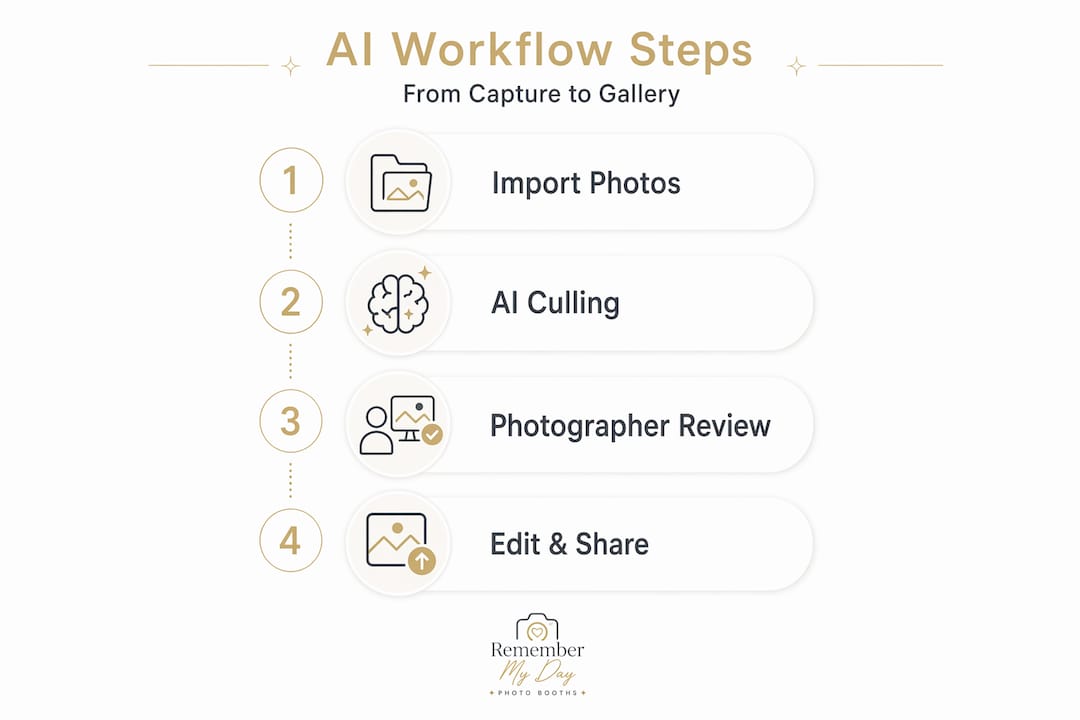
The most effective approach most working photographers use is a hybrid culling workflow. AI does the first pass, reducing a 3,000-image shoot to roughly 500 to 800 frames. A human editorial review then makes the final selections, preserving intentional creative choices that AI tools might flag incorrectly, like a deliberately blurred motion shot or a wide artistic frame.
Connectivity deserves more attention than it gets. Real-time photo delivery and live social sharing both depend on reliable data transfer in venues that are often hostile to wireless signals. Multi-connection systems that bond several data streams together have proven their value in demanding environments. Liveu’s bonded connectivity systems, for example, increased event media reach by 30% in broadcast conditions that challenged standard setups. The lesson for event photographers is to treat connectivity as critical infrastructure, not an afterthought.
Here are the practical questions worth asking before adopting any new tool for a live event:
- Does this tool work offline if the venue Wi-Fi fails?
- What is the per-image or per-event pricing structure, and does it scale reasonably for high-volume shoots?
- Does the interface work for guests of all ages and tech comfort levels, especially for photo booth interactions?
- How does this tool handle creative exceptions, or will I need to override it constantly?
78% of photographers now consider AI culling tools essential to their workflow, which tells you something important: this is no longer experimental technology. It is the new baseline. The best tech for event photographers is whatever lets you spend more time behind the camera and less time behind a screen.
Pro Tip: Always test any new tech tool at a low-stakes event before deploying it at a client’s wedding or corporate conference. A birthday party is a great proving ground. A black-tie gala is not.
My take on technology and creativity in event photography
I have watched photographers make the same mistake twice with technology. First, they resist it completely, convinced it threatens their craft. Then they embrace it so fully that their work starts to look identical to everyone else’s using the same AI presets and the same auto-culled galleries.
The truth I have come to is that AI enables photographers to meet the dual deadlines of capture quality and 24 to 72 hour delivery that clients now expect. That is genuinely valuable. But the creative decisions, what emotion to include, what imperfect moment tells the real story, those still require a human who was actually in the room.
What I tell event organizers is this: coordinate with your photography team about what technology they use before you finalize your event timeline. A photographer using real-time sharing can offer guests a QR code by cocktail hour. That changes how you program your event. Technology and creativity work best when they are planned together, not bolted on separately.
The photographers who will thrive are the ones who understand their tools deeply enough to know when to override them. AI will keep getting better. Your judgment about which moment actually mattered? That does not get automated.
— RMD
Bring your event to life with Rmdphotobooths
We at Rmdphotobooths love watching technology turn a great event into an unforgettable one. Our photo booth experiences are built around exactly the kind of technology this article describes: DSLR camera integration, cloud-connected instant sharing, branded digital galleries, and AI-enhanced captures that make every guest look their best. Whether you are planning a wedding in San Antonio, a corporate conference, or a private celebration, we bring the tools and the team to create those “wow” moments your guests will treasure forever.

We have earned over 1,000 five-star reviews by combining the best technology with genuine warmth and reliability. Our digital photo booth advantages go far beyond a quick snapshot. Ready to spark joy at your next event? Book your experience today and let us bring your vision to life.
FAQ
How does AI improve event photography workflows?
AI culling platforms sort thousands of RAW files in seconds, flagging technical flaws like blur and closed eyes so photographers can focus their review on creative selection rather than technical filtering.
What is the role of technology in event photography for photo sharing?
Technology enables real-time photo delivery through QR-based galleries, AI facial recognition, and branded cloud platforms, so guests can access and share their photos before the event ends.
Are digital photo booths better than traditional ones?
Modern digital photo booths use DSLR cameras, cloud connectivity, and instant sharing software to eliminate the delays of analog systems, delivering prints and digital files within seconds rather than minutes.
What are content credentials and why do they matter?
Content credentials attach cryptographic provenance metadata to images, recording capture and edit history to verify authenticity. They are especially relevant for corporate and editorial event photography where image integrity is critical.
How should event photographers handle connectivity challenges?
Using bonded multi-connection systems that combine several data streams provides reliable real-time uploads even in venues with weak Wi-Fi, protecting live sharing workflows from signal disruptions.