TL;DR:
- Digital and traditional photo booths offer distinct guest experiences, with digital setups enabling instant sharing and broader coverage, while traditional booths provide tangible keepsakes and interactive fun. Costs vary, with traditional rentals typically costing $800 to $2,500 and digital options often being more budget-friendly but involving software fees, space, and connectivity considerations. Most successful events benefit from a hybrid approach, combining both formats to maximize guest participation, memorable souvenirs, and social reach.
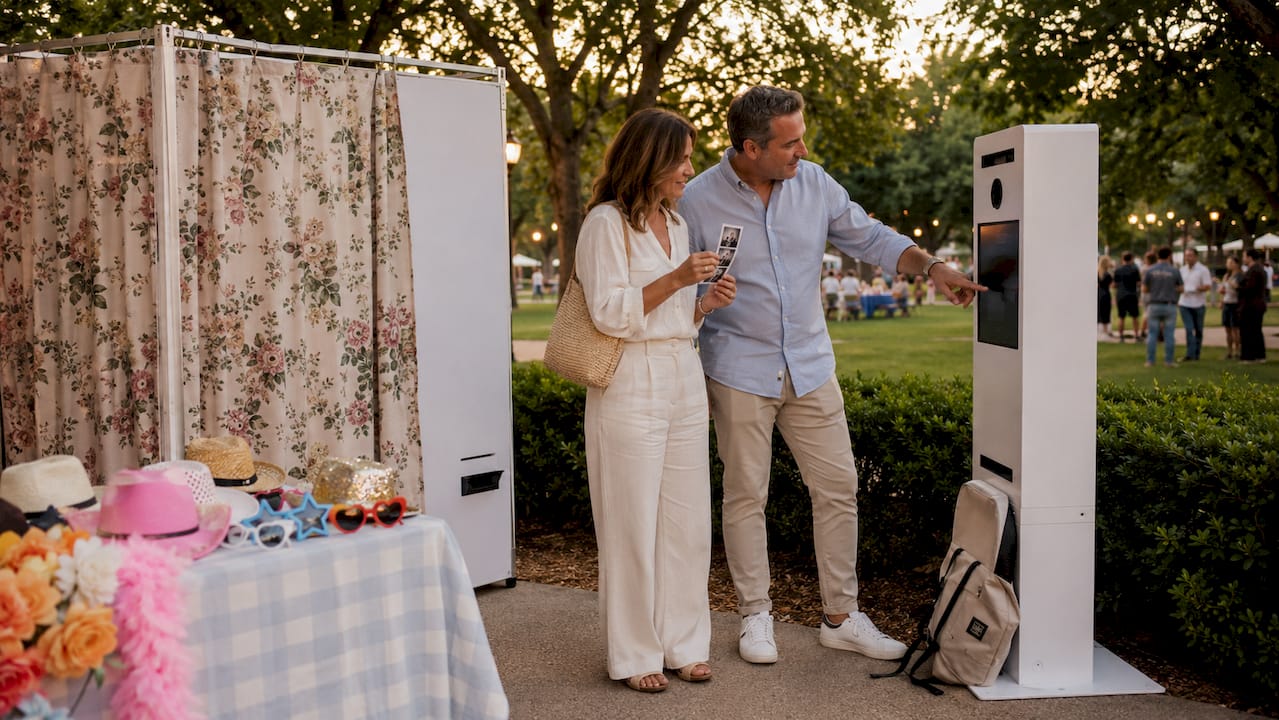
Digital and traditional photo booths are two distinct ways to capture and share event memories, each delivering a completely different guest experience. A digital photo booth uses software platforms like Simple Booth or dslrBooth to enable instant sharing, cloud galleries, and broad event coverage. A traditional photo booth relies on a fixed enclosure, physical props, and printed photo strips that guests take home as souvenirs. Knowing the difference between these two formats is the first step toward choosing the right memory-maker for your wedding, corporate event, or party. We at Rmdphotobooths have seen both formats spark pure joy at events across San Antonio, and we want to help you make the most informed choice possible.
How do digital and traditional booths compare in guest participation?
The participation gap between digital and traditional setups is significant and worth understanding before you book anything. Traditional photo booths capture 200 to 400 photos with roughly 40 to 60% guest participation, largely because guests must physically queue at a single fixed location. That queue creates a bottleneck, especially at receptions where guests are mingling, dancing, or eating. Digital setups, by contrast, can capture three to five times more photos because coverage spreads across the entire event rather than anchoring to one corner.
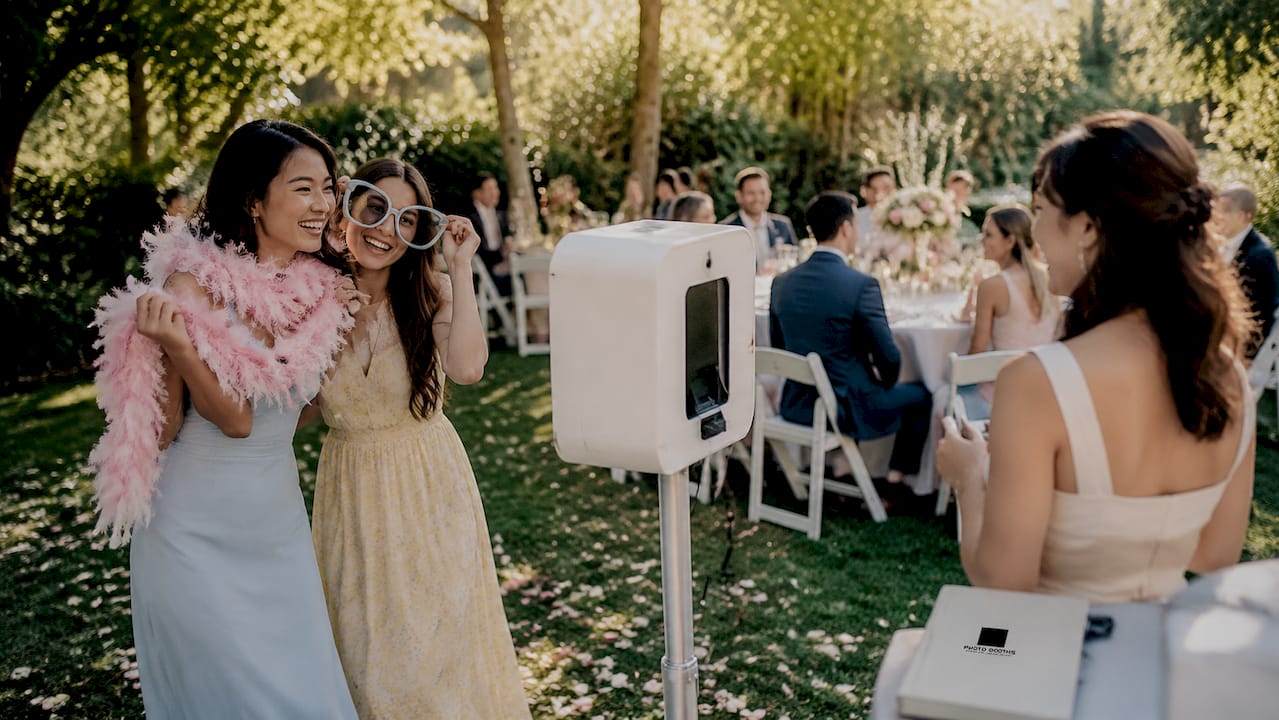
Digital booths also remove the wait entirely. Guests scan a QR code, snap a photo on their own device, and share it instantly to Instagram, Facebook, or Snapchat. Instant social media sharing multiplies your event’s reach in real time, turning every guest into a content creator. That kind of organic visibility is something a traditional booth simply cannot replicate on its own.
That said, traditional booths bring something irreplaceable to the table:
- Physical print souvenirs that guests treasure forever, especially the classic 2×6 photo strip
- Prop-driven fun that creates shared, spontaneous moments between guests who might not know each other
- A dedicated social space where groups gather, laugh, and bond over silly accessories
- Branded print strips that double as personalized keepsakes tied directly to your event theme
Pro Tip: If your guest list skews older or less tech-savvy, a traditional booth with a friendly attendant will almost always generate more genuine participation than a QR-based digital setup.
The entertainment value of a traditional booth is real and measurable. Guests gravitate toward the props, the curtain, and the countdown timer in a way that feels playful and nostalgic. Digital booths win on volume and reach. Traditional booths win on depth of experience per interaction.
What are the cost differences between digital and traditional photo booths?
Cost is where the comparison gets genuinely interesting, because the sticker price rarely tells the full story. Traditional booth rentals typically run $800 to $2,500 for a three to four hour event window. That price usually includes the physical unit, props, a print package, and sometimes an attendant. Digital options can be less expensive upfront, but software licensing and per-device fees add up fast.
| Factor | Traditional booth | Digital booth |
|---|---|---|
| Rental cost (3 to 4 hrs) | $800 to $2,500 | Varies; often lower base cost |
| Labor requirement | Attendant often included or required | Unattended setups are common |
| Space needed | Dedicated footprint (6 to 10 sq ft) | Minimal; signage and QR placement only |
| Consumables | Paper, ink, print cartridges | None for digital-only output |
| Software licensing | Bundled or minimal | Per-device fees, tiered features |
Labor is the hidden variable most event planners overlook. Staffed traditional booths increase labor costs by $130 to $190 per event, while unattended digital setups reduce attendant hours by 60%. That difference directly affects what you pay and what the operator earns. For a wedding with a tight budget, an unattended digital setup can free up hundreds of dollars for other priorities.
Physical footprint matters too, especially in smaller venues. A traditional booth needs a dedicated six to ten square foot space, clear sightlines, and ideally a backdrop. A digital setup needs a well-placed QR code sign and maybe a branded frame station. If your venue is a boutique ballroom or a backyard garden, that spatial difference is not trivial.
Pro Tip: Ask your rental provider whether software licensing is bundled into the quote. Per-device pricing can multiply quickly if the operator runs multiple units at your event, and that cost sometimes gets passed to the client.
For operators scaling multiple booths at large corporate events, software fees can run several thousand dollars per device per year. Understanding that cost structure helps you negotiate smarter and ask the right questions before signing a contract.
What are the key technical and privacy differences in 2026?
Technology and privacy compliance have become defining factors in the digital vs traditional booths conversation, particularly for corporate event organizers. Commercial photo booths are high-throughput data collection devices and must comply with GDPR and other privacy laws requiring explicit, granular consent, especially when biometric data or AI features are involved. Traditional booths that only print photos and collect no personal data carry far less compliance risk.
Digital booths that collect email addresses for gallery delivery, use facial recognition for sorting, or integrate AI portrait features require a carefully designed consent flow. A single checkbox at the start of the session is no longer sufficient under current privacy standards. The best practice in 2026 is a multi-step consent UX that lets guests opt in or out of specific data uses separately.
“Designing booth consent flows as granular multi-step UX rather than one checkbox improves guest confidence and legal safety.” — GDPR Event Data Privacy for Commercial Venues
Here are the key technical and privacy points to verify before booking a digital booth:
- Data storage location: Where are photos and emails stored? Is the server GDPR-compliant?
- Biometric processing: Does the booth use facial recognition or AI enhancement? If yes, explicit consent is legally required.
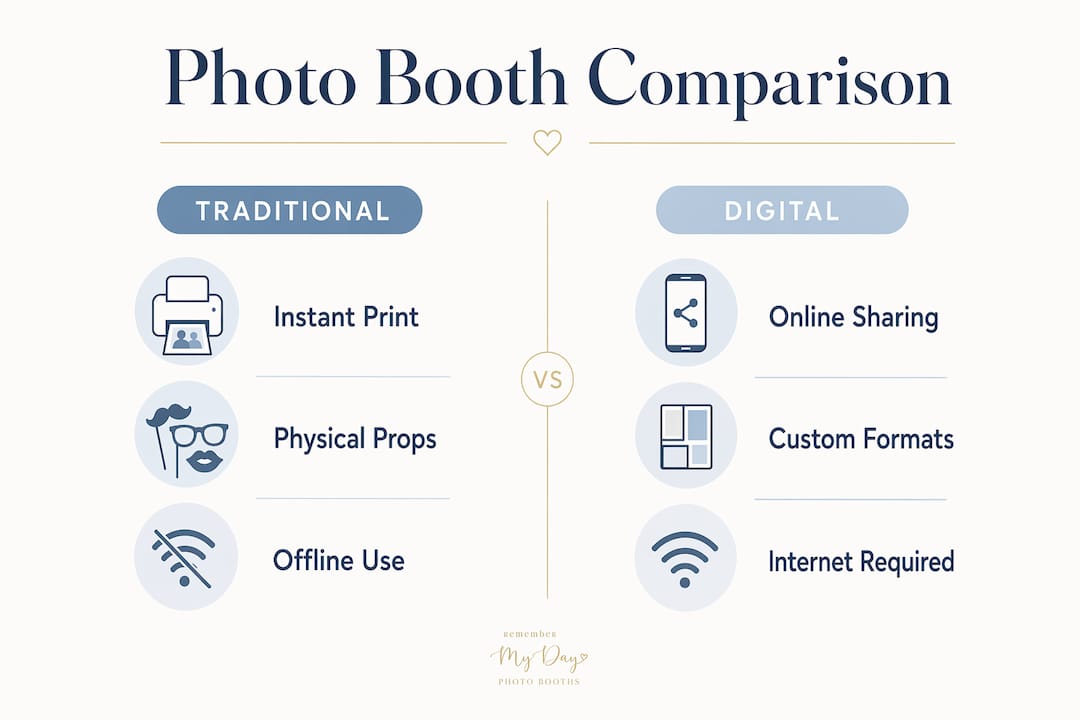
- Internet dependency: Digital booths need reliable Wi-Fi or a cellular hotspot. Traditional booths print locally and work offline.
- Connectivity backup: Ask whether the digital platform queues uploads if connectivity drops, or whether photos are lost.
Traditional booths have a reliability advantage here. They operate independently of internet connectivity, which matters at outdoor venues, rural properties, or older buildings with weak Wi-Fi. Digital booths offer cloud galleries and remote access, but that convenience comes with a connectivity dependency that can derail the experience if the network fails.
How do photo strip formats and outputs differ between booth types?
The physical output of a photo booth is often what guests remember most, and the specs behind that output matter more than most people realize. Common traditional print formats include 2×6 inch strips and 4×6 inch postcards, typically featuring a four-frame layout with branding space at the bottom. These prints require 300 DPI resolution to look sharp. Digital-only sharing files work fine at 150 DPI, which is why digital booth photos often look great on a phone screen but disappoint when printed at home.
| Output type | Format | Resolution needed | Sharing method |
|---|---|---|---|
| Traditional print strip | 2×6 inches, 4 frames | 300 DPI | Physical takeaway |
| Traditional postcard print | 4×6 inches | 300 DPI | Physical takeaway |
| Digital gallery share | Varies | 150 DPI minimum | Email, SMS, QR link |
| Social media share | Square or portrait crop | 150 to 300 DPI | Instagram, Facebook, Snapchat |
Template design is a detail that separates a polished booth experience from a frustrating one. Improper template sizing causes layout issues that show up immediately on physical prints, including cropped logos, misaligned text, and uneven borders. If you are ordering a custom-branded print for a wedding or corporate event, always request a printed proof before the event day.
Digital booths offer more flexibility in output formats. Guests can receive a standard photo, a GIF, a boomerang, or even an AI-enhanced portrait depending on the software platform. Tools like Simple Booth and Pix Wedding support multiple file formats and allow instant delivery via text or email. That variety gives digital setups a clear edge for events where shareability is the primary goal. Modern smartphones like the iPhone 14 and Galaxy S23 often exceed traditional booth image quality in low-light conditions, which means digital setups leveraging guest devices can actually outperform older traditional booth cameras in dimly lit reception halls.
Key takeaways
Choosing between digital and traditional photo booths comes down to three factors: your guest demographics, your venue size, and whether you prioritize shareability or a tangible souvenir.
| Point | Details |
|---|---|
| Participation rates differ sharply | Traditional booths reach 40 to 60% of guests; digital setups can capture three to five times more photos. |
| Cost goes beyond the rental fee | Labor, software licensing, and consumables add meaningful cost to both booth types. |
| Privacy compliance is non-negotiable | Digital booths collecting emails or using AI features require granular, multi-step consent flows in 2026. |
| Print quality requires 300 DPI | Digital sharing works at 150 DPI, but physical prints need 300 DPI to avoid visible quality loss. |
| Hybrid setups maximize both worlds | Combining a traditional booth for reception fun with digital sharing for full-event coverage satisfies every guest type. |
What we’ve learned after hundreds of events in San Antonio
After working more than a thousand events across San Antonio, we have a clear opinion: the digital vs traditional booths debate is mostly a false choice. The real question is what your guests will actually use and love on the night.
We have seen traditional booths become the heart of a wedding reception, with guests lined up three deep to grab the feather boas and oversized sunglasses. We have also seen digital setups at large corporate galas where the QR gallery captured 1,200 photos that would never have happened with a single fixed booth. Neither format is universally better. Both are genuinely great at what they do.
What we push back on is the assumption that digital automatically means modern and traditional automatically means outdated. A beautifully branded personalized photo booth experience with custom print strips and a warm attendant creates a memory that a QR code link simply cannot replicate. At the same time, a well-executed digital setup at a 300-person gala captures moments that a single enclosed booth would miss entirely.
Our honest recommendation for most weddings and mid-size parties: go hybrid when your budget allows. Use a traditional booth as the reception centerpiece and layer in a digital sharing station for full-event coverage. Combining both formats gives you the tangible souvenir guests treasure and the social reach that keeps your event alive online long after the last dance. That combination, in our experience, consistently produces the highest guest satisfaction of any single-format setup.
— RMD
Find your perfect booth experience with Rmdphotobooths
Whether you are drawn to the charm of a printed photo strip or the instant shareability of a digital gallery, Rmdphotobooths has a setup built for your celebration. We serve weddings, corporate events, private parties, and large-scale galas across San Antonio with over 1,000 five-star reviews behind us.

From classic traditional photo booth rentals with custom-branded strips to 360° booths, glam booths, and AI-powered portrait experiences, our team tailors every setup to your venue, guest count, and event style. Browse our full range of photo booth experiences to find the format that fits your vision, and when you are ready to make it official, book your date before your preferred slot fills up.
FAQ
What is the main difference between digital and traditional photo booths?
A traditional photo booth prints physical photo strips on-site, while a digital booth delivers images via email, SMS, or QR link for instant sharing. Traditional booths focus on tangible souvenirs; digital booths prioritize reach and volume.
How much does a traditional photo booth rental cost?
Traditional photo booth rentals typically cost $800 to $2,500 for a three to four hour event, depending on location, features, and whether an attendant is included. Digital options often have a lower base price but may carry software licensing fees.
Do digital photo booths require internet access?
Yes. Digital booths depend on Wi-Fi or a cellular hotspot to deliver photos and sync cloud galleries. Traditional booths print locally and operate without any internet connection, making them more reliable at venues with weak connectivity.
Can I combine a digital and traditional booth at the same event?
Absolutely. Hybrid setups that pair a traditional booth for reception-based fun with a digital sharing station for full-event coverage are one of the most popular configurations in 2026. They maximize both guest participation and the number of photos captured.
What resolution do photo booth prints need to look sharp?
Physical prints require 300 DPI to look crisp and professional. Digital sharing files work well at 150 DPI, which is why photos that look great on a phone screen can appear blurry when printed at home on standard paper.