
TL;DR:
- A photobooth vendor contract for corporate events is a legally binding document that defines service scope, technical requirements, data ownership, and financial obligations. Without such an agreement, planners risk disputes over data rights, equipment failures, and costs that generic templates cannot address. A well-structured contract protects your organization by including clear event details, service descriptions, payment terms, technical specs, liability clauses, and data privacy provisions.
A photobooth vendor contract for corporate events is a legally binding document that defines service scope, technical requirements, data ownership, and financial obligations between your organization and a photo booth provider. Without a purpose-built agreement, planners risk disputes over data rights, equipment failures, and cost overruns that generic event templates simply do not address. This photobooth vendor contract corporate guide walks you through every critical clause, compliance requirement, and negotiation tactic you need to protect your event and your organization. Whether you are booking a traditional photo booth or a 360° experience, the contract is where professional events are won or lost before the first guest arrives.
What does a photobooth vendor contract corporate guide cover?
A photobooth rental agreement for corporate events goes far beyond a standard service contract. Legal enforceability requires accurate party identification, a clear service scope, cancellation policies, liability limits, and signatures from both parties. That baseline is just the starting point for enterprise events, where data privacy laws like GDPR and CCPA, IT security standards like SOC 2 and ISO 27001, and internal procurement policies add layers of complexity. Planners who treat a photo booth booking like a catering order routinely discover those gaps at the worst possible time.
The industry term for this type of agreement is a “vendor master service agreement” or MSA, often supplemented by a statement of work (SOW) for each event. Using both an MSA and a SOW gives you modular flexibility. You negotiate the legal and compliance terms once, then attach event-specific details as a separate SOW without re-signing the full contract every time.
Key components every corporate photobooth contract must include
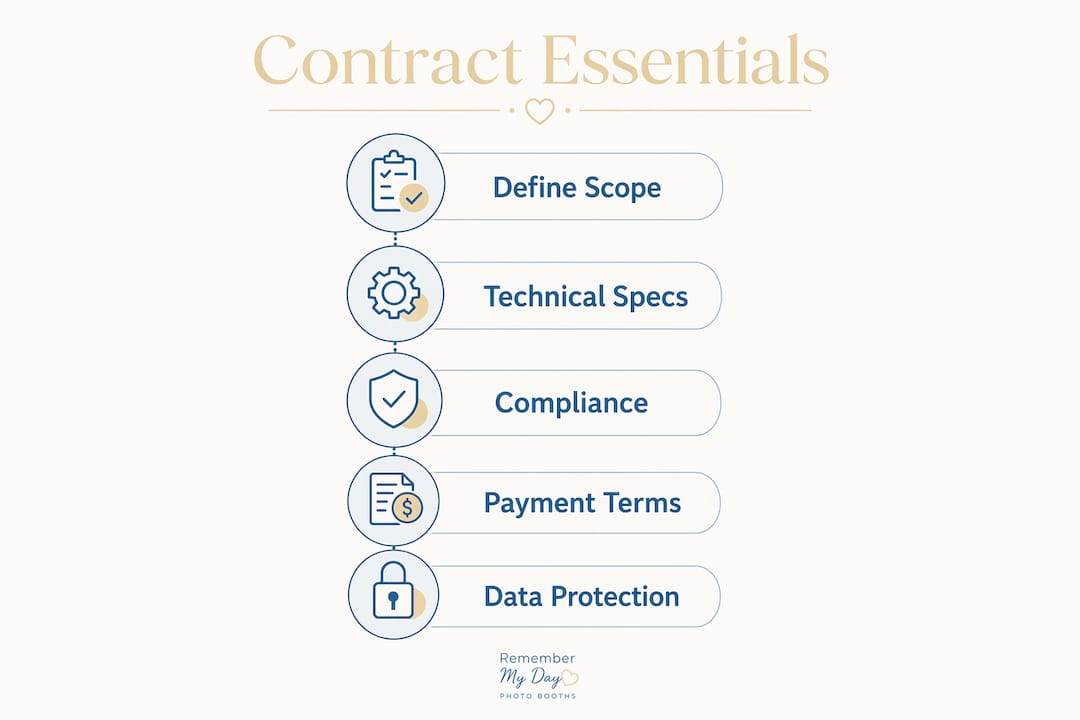
A well-built photobooth contract template for corporate events covers six distinct areas. Each one protects a different aspect of your event.
- Event details. Specify the exact date, venue address, setup start time, teardown deadline, and total active hours. Vague language like “evening event” creates billing disputes.
- Service description. Name the booth type (traditional, 360°, glam, AI-powered), staffing levels, print quantities, digital delivery format, and any branded overlays or custom templates. Booth type selection directly affects what your SOW must specify.
- Payment terms. Photobooth rental pricing typically ranges from $350 to $1,200 depending on booth type, duration, and location. Your contract must state the deposit amount, payment schedule, overtime rate per hour, and the refund window for cancellations.
- Technical requirements. Define the power draw in amps, dedicated circuit needs, minimum internet bandwidth for instant sharing, and floor space dimensions. These are contract specs, not setup notes.
- Liability and insurance. Require the vendor to carry general liability insurance with your organization named as an additional insured. Cap vendor liability at a defined dollar amount and include mutual indemnification language.
- Data ownership and privacy. State that all guest data collected at the booth belongs to your organization. Require the vendor to act only as a data processor under a signed Data Processing Agreement (DPA).
How do you integrate compliance requirements into vendor agreements?
Compliance clauses are the section most planners skip and most vendors prefer you skip. That is a costly mistake for any corporate event photobooth service operating under GDPR, CCPA, or internal IT security policies.

Start with the DPA. Enterprise procurements must include DPAs with retention and deletion SLAs, GDPR and CCPA compliance language, and network egress lists for IT approval. A DPA specifies the lawful basis for data collection under GDPR Article 6(1)(a), consent screen requirements, processor roles, and data portability obligations. Without it, your vendor may legally retain and reuse guest photos and contact data.
Next, address IT security. Require the vendor to hold SOC 2 Type II or ISO 27001 certification, or to complete your organization’s security questionnaire. Specify encryption in transit and at rest for all guest data. If the booth uses cloud-dependent features like instant digital sharing or AI filters, require a documented uptime SLA of 99.5% to 99.9% with defined incident response tiers.
- Request the vendor’s SOC 2 or ISO 27001 certificate before contract execution. If unavailable, require a completed security questionnaire reviewed by your IT team.
- Add network whitelisting requirements. List the IP ranges and domains the booth software needs to reach so your venue’s IT team can approve them in advance.
- Define data export format. Require CSV or JSON export of all lead capture data on demand. Many vendor agreements default data ownership to the vendor or grant broad reuse rights. Rewrite that clause explicitly.
- Set a data deletion SLA. Specify the number of days after the event by which the vendor must delete all guest data from their servers and confirm deletion in writing.
- Include connectivity contingency terms. State what happens to the service and billing if the venue’s internet fails. A good contract assigns responsibility and defines a service credit.
Pro Tip: Ask your vendor for a sample DPA before you finalize the MSA. If they cannot produce one within 48 hours, treat that as a red flag for their overall data governance maturity.
How do you negotiate terms with photobooth vendors for corporate events?
Strong negotiation starts before you contact a single vendor. Enterprise photo booth procurement benefits from a structured RFP with a scoring rubric that evaluates vendors on price, security posture, service history, and contract flexibility. A documented scoring sheet also speeds up internal approvals by giving finance and legal a clear basis for the decision.
- Prepare a written RFP. Include your technical specs, compliance requirements, preferred contract terms, and evaluation criteria. Vendors who cannot respond to a structured RFP rarely perform well under a detailed contract.
- Set uptime and support SLAs upfront. Define acceptable downtime during the event, the response time for onsite technical issues, and the remedy (service credit, partial refund, or replacement equipment).
- Negotiate IP and brand asset ownership. Your logo, branded overlays, and custom templates are your property. The contract must state that the vendor receives a limited license to use them only for your event and must delete them afterward.
- Include termination and force majeure clauses. Define the notice period for termination by either party, the refund schedule tied to notice timing, and the conditions that qualify as force majeure.
- Address modification authorization. Contracts should explicitly address configuration error grace periods and modification authorization rights to minimize disputes over event changes. Specify who on your team can authorize changes and require written confirmation for any modification.
The delivery fee negotiation guide from Rmdphotobooths is a practical reference for structuring payment and logistics clauses. For the internal approval process, a one-page TCO summary attached to the contract package accelerates sign-off from finance and AP teams who are unfamiliar with event vendor agreements.
Pro Tip: Pre-brief your legal, IT, and finance deputies before the contract lands in their queue. A 15-minute walkthrough of the key clauses cuts review time dramatically and prevents last-minute redlines that delay your event.
What are the most common mistakes in corporate photobooth contracts?
Generic event contract templates fail to address photo booth-specific technical variables like power requirements, connectivity for instant sharing, and weather limits. Analysis of over 159,000 event contracts confirms this pattern. Planners who adapt a standard catering or AV contract for a photo booth booking consistently encounter the same gaps.
- Missing billable idle time and late start policies. If your event runs behind schedule and the booth sits idle, who pays? Define the idle time rate and the grace period before overtime charges begin.
- No outdoor or weather limits. If your event has an outdoor component, the contract must specify the temperature range, wind speed limit, and precipitation threshold at which the vendor can refuse to operate without penalty.
- Vague data ownership language. Vendor master service agreements often default data ownership to the vendor. Rewrite the clause to confirm your organization owns all guest data and the vendor acts solely as a processor.
- No equipment damage protocol. Define who is liable for equipment damage caused by guests, venue conditions, or vendor error. Require the vendor to carry equipment insurance and specify the claims process.
- Unsegregated business and service terms. Contracts that mix business terms like payment and indemnity with service-specific clauses require a full re-sign whenever the service scope changes. Separate them into distinct sections for modular flexibility.
“A photo booth contract that does not specify power requirements, connectivity needs, data ownership, and weather limits is not a contract. It is a deposit receipt with good intentions. Every operational dispute we see traces back to a clause that was assumed, not written.”
Key Takeaways
A solid photobooth vendor contract for corporate events requires explicit technical specs, data ownership clauses, compliance language, and modular structure to protect your organization and your guests.
| Point | Details |
|---|---|
| Define technical specs in the contract | Power draw, internet bandwidth, and floor space must appear as contract terms, not setup notes. |
| Require a signed DPA | A Data Processing Agreement confirms the vendor acts as a processor and must delete guest data after the event. |
| Segregate business and service terms | Keeping payment and indemnity clauses separate from service-specific terms prevents full re-signs when scope changes. |
| Use a structured RFP with scoring | A documented scoring rubric speeds internal approvals and creates a defensible vendor selection record. |
| Address outdoor and idle time clauses | Weather limits and billable idle time policies prevent the most common operational billing disputes. |
What we have learned from years of corporate event contracts
We have worked through enough corporate event agreements at Rmdphotobooths to know where the friction points live. The biggest one is not pricing. It is the gap between what a planner assumes is covered and what the contract actually says.
Early legal and IT involvement changes everything. When those teams see the contract before the vendor is selected, they catch data ownership gaps and security requirements while there is still time to negotiate. When they see it the week before the event, they create delays or, worse, approve a contract that exposes the organization.
We also believe modular contract language is underused. Separating your MSA from your SOW means you negotiate the hard legal terms once and update only the event-specific details for each booking. That structure respects everyone’s time and builds a stronger vendor relationship over multiple events.
The planners who get the most from their corporate photo booth experience are the ones who treat the contract as a communication tool, not just a legal formality. A clear contract tells your vendor exactly what success looks like. That clarity produces better events, fewer disputes, and guests who leave with memories they will treasure forever.
— RMD
Rmdphotobooths: corporate-ready photo booth services built for planners
Corporate event planners deserve a vendor who makes the contract process as smooth as the event itself. Rmdphotobooths brings over 1,000 five-star reviews and deep experience across corporate events, conferences, and large-scale celebrations in San Antonio and beyond.

We offer flexible, transparent contract terms designed to meet enterprise compliance needs, including clear data ownership language and staffed booth options that remove operational guesswork from your planning process. From traditional photo booths to 360° experiences and AI-powered booths, every service comes with the documentation and support your legal and IT teams expect. Ready to see what a contract-ready corporate photo booth experience looks like? Explore our experiences or book your event today and let us help you create those “wow” moments your guests will treasure forever.
FAQ
What must a corporate photobooth vendor contract include?
A corporate photobooth rental agreement must include event details, service descriptions, payment terms, technical requirements, liability and insurance clauses, and a signed Data Processing Agreement. Legal enforceability also requires accurate party identification and signatures from both parties.
How do I protect guest data in a photobooth contract?
Require a Data Processing Agreement that names your organization as the data controller and the vendor as the processor. The DPA must specify data retention limits, a deletion SLA, and guest data export rights in CSV or JSON format.
What is a typical price range for corporate photobooth rentals?
Photobooth rental pricing typically ranges from $350 to $1,200 depending on booth type, duration, and location. Most vendors charge per hour with a minimum rental period, so your contract should define the overtime rate clearly.
Why should I separate business terms from service terms in the contract?
Segregating business terms like payment and indemnity from service-specific clauses means you can update the service scope without re-signing the entire agreement. This modular structure saves time and reduces legal review costs for repeat events.
What security certifications should I require from a photobooth vendor?
Require SOC 2 Type II or ISO 27001 certification, or ask the vendor to complete your organization’s IT security questionnaire. For cloud-dependent features, require a documented uptime SLA of 99.5% to 99.9% with defined incident response tiers.