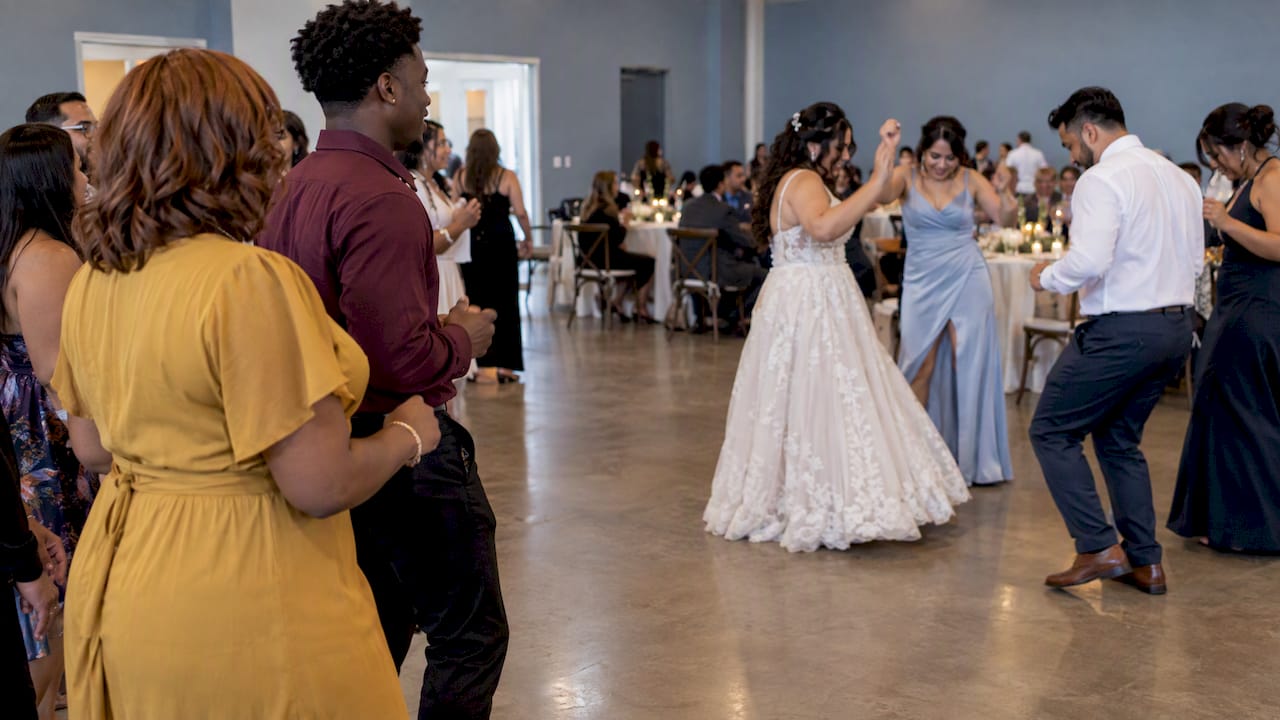
A 360 booth is safe at your event when four things are true: a trained attendant runs it, the platform sits on level ground with room around it, every cable is routed out of the way, and guests get a few simple rules before they step on. Everything else is detail, and we’ll walk you through that detail here, so you can say yes to the fun and stop worrying about the what-ifs.
We’ve helped hosts across Texas add 360 video to weddings, galas, quinceañeras and company parties, and the same handful of questions come up every time. How much space do we need? How many people can stand on it? What about the cords? What should the video overlay say? We answer them all below.
TL;DR
- Book a booth that comes with a trained attendant who can pause the rotation at any moment, and brief that person on your venue before the event.
- Give the booth a flat, level spot with clear space on every side, plus a separate area where guests can line up.
- Ask the provider for the manufacturer’s weight rating for the exact platform, and keep the group size well within it.
- Keep cables off walkways, avoid overloaded outlets and check cords for damage before the doors open.
- Design your overlay with safe margins and big, bold text, then test it on a real spin.
Table of Contents
- What makes a 360 booth different from a safety standpoint
- Start with the attendant
- How much space a 360 booth needs
- The weight limit question
- Power and cables
- Guest rules that keep everyone safe
- Safe by design: choosing a provider
- Our perspective
- 360 overlay ideas that look great and stay readable
- Day-of timeline for a safe 360 booth
- Book a 360 booth with us
- FAQ
- Sources
What makes a 360 booth different from a safety standpoint
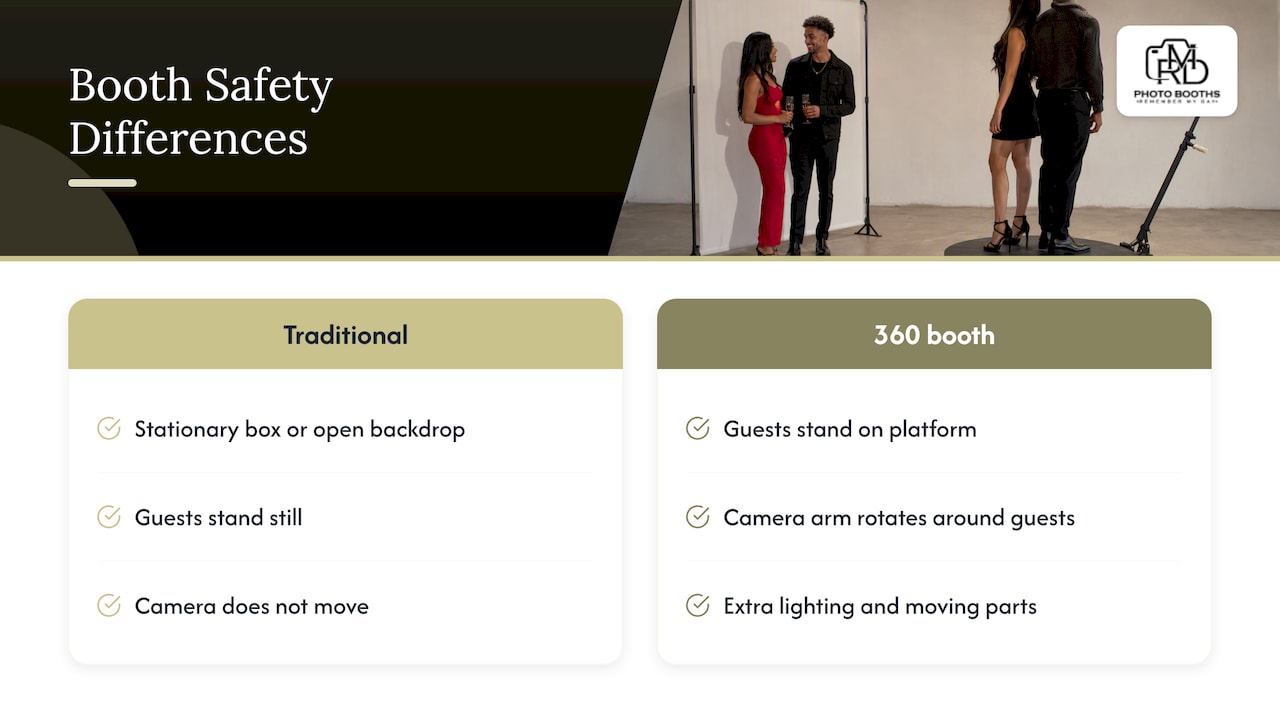
A traditional booth is a stationary box or open backdrop. Guests stand still and the camera does not move. A 360 booth is different: guests stand on a platform while a camera arm rotates around them, usually with a smartphone or camera mounted on it. You have a moving part, a raised surface, extra lighting and often a small crowd of people dancing, posing and filming at once.
None of that is a reason to skip it. It is a reason to treat the booth like any other piece of event equipment, the way you would a DJ rig or a dance floor. If you want a side-by-side look at how the two formats compare on footprint and cost, our 360 photo booth vs traditional booth guide covers it.
Start with the attendant
The single biggest safety feature of a 360 booth is a person. A trained attendant watches the platform, greets each group, explains how it works and keeps the line moving. Just as important, a good attendant carries a wireless remote and can pause the arm the moment something looks off: a child wandering toward the platform, a guest losing balance, or someone reaching toward the arm.
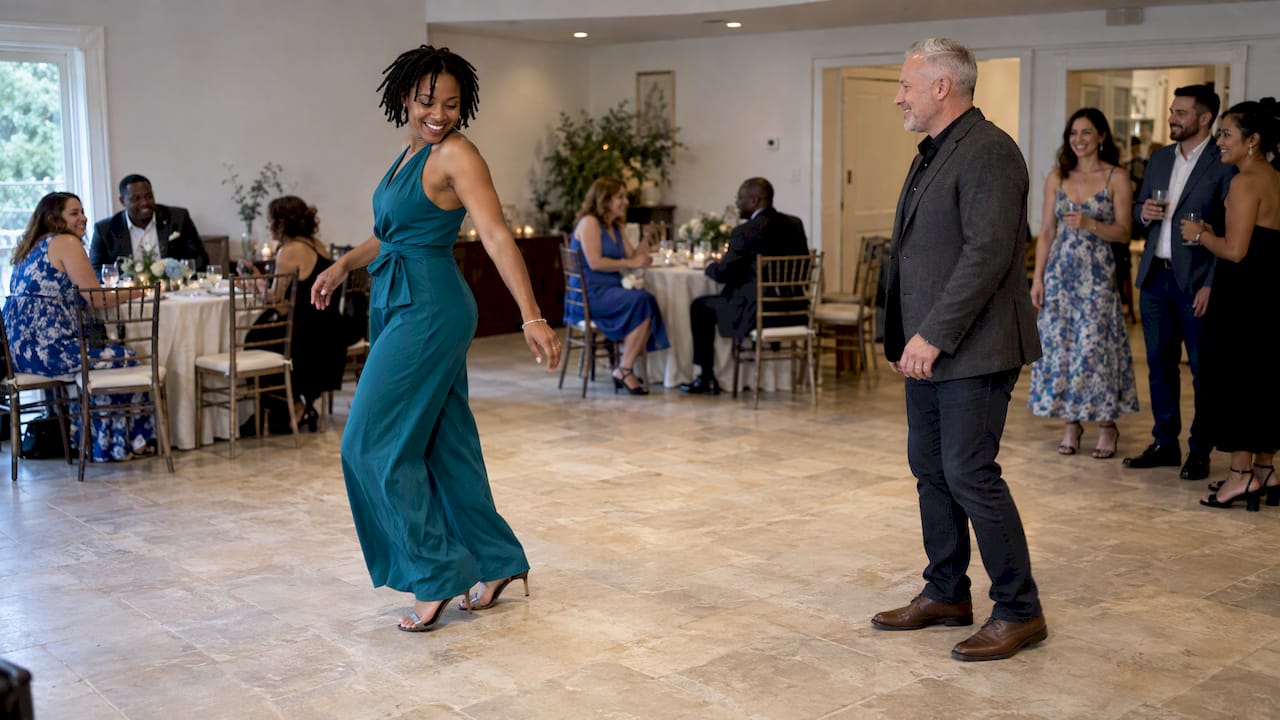
We always staff our booths. If you are weighing a drop-off or unattended option because it costs less, think about who will step in when a guest in heels, a ring bearer or a very excited uncle gets close to a moving arm. At a celebration with food, drinks and a dance floor, an unattended spinning arm is a risk we would not ask you to take.
In a rare emergency, a spinning arm can be stopped by hand as a last resort, but that is exactly why you want someone trained standing next to it. Attendants should use the remote first, and they should know where the power switch is.
What a good attendant does
- Greets every group and explains the rules in about thirty seconds.
- Checks that guests are balanced and in the center of the platform before starting.
- Keeps children and pets away from the arm and out of the spin zone.
- Limits the number of people per spin to what the platform comfortably holds.
- Watches the queue so nobody crowds the edge of the platform.
- Stops the rotation at the first sign of trouble, then restarts when everyone is steady.
How much space a 360 booth needs
Space is safety. A booth wedged into a corner leaves no room for the arm, the guests or the line. Many providers plan for a footprint of about 10 by 10 feet for the platform, with extra clearance around it so guests can step on and off without bumping into walls, tables or decor. Needs vary by model and by the arm’s reach, so ask your provider for the exact dimensions of the setup they are bringing.
On top of the booth footprint, plan for three things:
- A queue area. Guests should wait off to the side, not at the platform’s edge. Give the line its own space, a few feet back from the booth.
- An operator zone. The attendant needs a spot with a clear view of the platform and easy access to the equipment.
- An unobstructed route. The booth should never block an exit, a service aisle or a restroom hallway.
We walk through the layout questions in our setup guide’s planning step, and our venue preparation steps help you ask the venue the right questions before load-in. If your room is tight, a smaller format can be the smarter choice, and our open air booth space page shows how little room some setups need.
Ceilings and floors
Look up, not just around. A rotating arm with a raised camera and lighting needs open air overhead. Chandeliers, low drapery, string lights and ceiling decor can all get in the way. The floor matters too: the platform needs a hard, flat, level surface. Soft ground, a sloped patio or a wobbly temporary floor can make the platform unsteady. If your event is outdoors, tell us early so we can plan the surface.
The weight limit question
Hosts ask about weight limits because they picture eight friends piling on at once. It is a smart question. The honest answer is that the limit depends on the model, and manufacturers publish different ratings for different platform sizes. Platforms are commonly sold in a few diameters, and the larger the platform, the more weight and the more people it is rated for.
What to do with that:
- Ask for the rating. Ask your provider for the manufacturer’s weight rating for the exact platform they will bring, and how many guests per spin they allow.
- Think in people, not just pounds. A rated total is a ceiling, not a target. Group size should also be limited by how much room guests need to move without stepping off.
- Plan for the real crowd. Wedding parties, sports teams and kids who jump are heavier on the platform than their numbers suggest. Tell the attendant to hold groups to a comfortable size.
- Keep it off the dance-floor logic. The platform is for posing, not for dancing wildly or jumping. Guests can still be silly, just on solid footing.
If a provider cannot tell you the platform’s rating or the manufacturer behind it, treat that as a yellow flag.
Power and cables
Cables are the quiet hazard at most events. A 360 booth needs power for the motor, the lights and often a screen or sharing station. Loose cords across a walkway are a tripping risk, and damaged or overloaded cords are a fire risk.
The U.S. Consumer Product Safety Commission has warned that pinching or crushing electrical cords can lead to fires, and recommends inspecting electrical equipment periodically for damaged insulation or overheating. That is the standard we hold ourselves to before every event.
Here is our practical version:
- Route cords along walls or under cable ramps rather than across open floor.
- Don’t overload one outlet. If your DJ, caterer and photo booth are all on the same circuit, tell us. Our photo booth power guide for venues explains what to ask a venue manager.
- Check the platform cords. Before the booth is used, the stage should be adjusted parallel to the ground and the power cord and the base’s LED strip cord should be checked so nothing is caught on the rotating parts.
- Inspect for damage. Frayed insulation, warm plugs or bent prongs mean the cord gets replaced, not taped.
- Keep drinks away. Spilled drinks and electrical equipment do not mix. A small side table for glasses solves most of this.
Our setup guide’s assembly step shows how we secure components, and our equipment step lists what we bring so you don’t have to guess.
Guest rules that keep everyone safe
The best safety briefing is short, friendly and repeated by the attendant. We suggest a small sign near the booth and a quick verbal rundown. The rules are simple:
- Step on and off carefully, especially in heels, dress shoes or on a crowded night.
- Stand in the center of the platform and keep arms and props inside the circle.
- Hold on to a drink or a bouquet, not a stranger. Better yet, leave glasses at the table.
- Stay clear of the arm. Don’t reach for it, hang on it or try to stop it.
- Follow the attendant’s cue. When they pause the spin, everyone holds steady.
- Kids need a grown-up. Children should be accompanied and kept away from the platform unless the attendant and a parent are right there.
Things like long trains, dangling decor, confetti cannons and big props deserve a quick check. A wedding dress train on a platform is beautiful on video and a trip hazard on the way down, so we help brides and bridesmaids step on with room to spare.
Safe by design: choosing a provider
Safety is partly a hiring decision. Before you sign, ask any provider:
- Is an attendant included for the whole booking, and are they trained on this equipment?
- What is the platform’s manufacturer weight rating, and how many guests per spin do you allow?
- What space and power do you need, and will you do a site check?
- What does the platform surface and edge look like, and is the step-up low?
- What happens if equipment fails mid-event?
A professional provider answers these quickly and plainly. A vague answer is useful information too.
Our perspective
We’ve run booths at more than 5,000 events, and the pattern is clear: the events that go smoothest are the ones where safety is planned, not improvised. Our San Antonio team treats the 360 booth like a stage. It needs a flat spot, clean power, an attendant who knows the equipment, and a host who has told us about anything unusual in the room.
We would rather ask you five extra questions during planning than have a surprise on the day. If your venue is tight, we will suggest a different spot or a different booth. If your guest list includes lots of kids, we will adjust how we run the line. Fun and safety are not opposites. When guests feel secure, they relax, and that is when the best videos happen.
— RMD
360 overlay ideas that look great and stay readable
Your overlay is the graphic frame that appears on every video. Because the video spins, the design has to work in motion, and because guests share it on phones, it has to be readable at a glance. Nothing here is a safety issue, but a clean overlay does keep guests from asking the attendant to redo spins, which keeps the line shorter and the platform less crowded.
Wedding overlays
The classic approach is the couple’s names or monogram plus the date, in clean typography with a light floral touch. Keep it elegant and restrained: coordinate the design with your invitation suite rather than repeating every detail from it. A soft script for the names and a simple sans-serif for the date reads well in motion.
Corporate overlays
Use the company logo, brand colors and perhaps a short tagline or event hashtag. Put the logo in a corner or along the bottom so faces stay clear. For a product launch or conference, a campaign color wash with one bold line of text gets shared more than a cluttered banner.
Private party overlays
Milestone birthdays, graduations, quinceañeras and holiday parties are made for themed colors, custom graphics and illustrations. Think a big number for the age, a school mascot, or a neon style for a night-out theme.
Design rules that work
- Leave the center transparent. The guests are the point.
- Keep key text away from the edges. A margin of roughly 30 to 50 pixels keeps names and logos from being cut off after cropping.
- Go bold and high contrast. Thin, pale lettering vanishes against a bright dance floor.
- Test a real spin. Check how the text looks against both light and dark backgrounds and at the final video resolution.
- Fewer words. Names, date, hashtag. That’s it.
Bring us your invitation, logo or color palette and we’ll help you shape something that fits. Our gallery has real examples to spark ideas.
Day-of timeline for a safe 360 booth
A quick run of show keeps everything calm. We outline the full approach in our event day run of show guide, and the short version looks like this:
- Before the event: share the floor plan, power locations and load-in time with us.
- Load-in: we set up on a level surface, route cables and test the rotation.
- Doors open: the attendant introduces the booth to early arrivals and sets the rules.
- Peak hours: the attendant manages the queue and keeps groups to a safe size.
- Wrap-up: we power down, coil cords and check that the area is clear.
If you want a broader look at how a booth gets installed, our photo booth setup process guide and the step-by-step setup guide go deeper.
Book a 360 booth with us
Our 360 Booth starts at $1,295 per event, and our Glambot® by RMD, a cinematic robotic-arm experience, starts at $2,795. Every booking comes with a team that plans the space, power and flow with you. See the 360 photo booth rental in San Antonio, browse everything on our experiences page, or go straight to booking. Hosting in Austin? We have a page for that too.
FAQ
Is a 360 photo booth safe for kids?
Yes, with supervision. Children should be with a parent and stay clear of the arm and platform edge. Our attendant can pause the rotation if a child gets too close or a guest loses balance.
Can a 360 booth run without an attendant?
We don’t recommend it. A trained person can pause the arm with a remote, manage the line and spot cord or balance problems before they become accidents. That matters most at crowded, festive events.
How much space do I need for a 360 booth?
Many setups call for around 10 by 10 feet plus clearance, a separate queue area and room for the attendant. Ask your provider for the exact footprint of their model and share your floor plan so they can confirm it fits.
What is the weight limit on a 360 platform?
It depends on the manufacturer and platform size, so ask your provider for the rating on the exact platform they bring. Then keep groups below it, with enough room for everyone to stand comfortably in the center.
What should a 360 overlay include?
Keep it simple: names and a date for weddings, a logo and tagline for corporate events, or a themed graphic for parties. Leave the center clear, keep text away from the edges and test it on a real spin.
Sources
Recommended
- Venue Photo Booth Preparation Steps for Flawless Events
- Photo Booth Etiquette: Making Every Snapshot Memorable
- 360 Photo Booth vs Traditional Booth: Check Space and Cost
- Ultimate Event Photo Booth Setup Guide for Events
This article was created with the assistance of automated AI content tools using publicly available information and may contain errors, omissions, or outdated information. Content is provided for general informational purposes only and does not represent an endorsement, criticism, or official statement regarding any person, business, product, or service mentioned. Business details, pricing, services, availability, and other information may change over time. If you believe any information is inac