TL;DR:
- Diversifying booth offerings reduces revenue risk and increases revenue potential across various event types. Different booth formats appeal to specific audiences, boosting guest engagement and satisfaction while expanding business stability. Modular, scalable designs help operators improve efficiency, lower costs, and serve more clients across diverse venues.
Booth offering diversification is defined as providing multiple types of interactive photo experiences at events to serve different guest preferences and maximize revenue across weddings, corporate events, and private parties. Event organizers who rely on a single booth type leave money on the table and expose their programs to market shifts. The most effective approach to why diversify booth offerings comes down to three drivers: risk reduction, guest engagement, and revenue growth. Rmdphotobooths has built its reputation across San Antonio on exactly this principle, combining traditional booths, 360° experiences, glam setups, vintage options, and AI-powered portraits into one cohesive portfolio.
Why diversify booth offerings to reduce risk and stabilize revenue
Relying on one booth type creates revenue concentration risk. When demand for that format softens, whether due to seasonal shifts, client budget changes, or new trends, your entire income stream feels the pressure. Diversification mitigates this risk by spreading revenue across multiple client segments, so a slow wedding season does not cancel out a strong corporate quarter.
“Offer portfolios that prevent revenue concentration are the foundation of a resilient event business. Spreading offerings across diverse client segments promotes stable cash flow and protects against market shifts that can devastate single-product operators.”
The math is straightforward. A standard iPad booth might generate a reliable base income, but 360° booths can generate double to triple the revenue per event, with per-event pricing ranging from $1,500 to $3,500. That revenue ceiling simply does not exist when you offer only one format.
Operators who serve corporate clients, wedding couples, and private party hosts simultaneously weather downturns far better than those locked into one niche. Each client segment has different budget cycles, seasonal peaks, and experience expectations. Matching your portfolio to those differences turns volatility into opportunity.
What are the key types of booth offerings event planners should consider?
The photo booth industry now spans several distinct experience categories, each with a different audience fit and price point. Knowing which type serves which event is the first step toward smart diversification.
| Booth Type | Best Event Fit | Engagement Level | Typical Price Range |
|---|---|---|---|
| Traditional DSLR print booth | Weddings, private parties | High (tangible keepsake) | $800–$1,200 |
| iPad open-air booth | Corporate events, casual parties | Moderate | $500–$900 |
| 360° video booth | Weddings, brand activations | Very high | $1,500–$3,500 |
| Glam booth | Weddings, galas, bridal showers | High (luxury feel) | $1,000–$2,000 |
| AI-powered portrait booth | Corporate events, upscale parties | Very high (novelty factor) | $1,200–$2,500 |
| Vintage booth | Themed parties, rustic weddings | High (aesthetic appeal) | $900–$1,500 |
Data shows that 23.5% of successful multi-booth operators add print capabilities as their first expansion move, while 13.7% add 360° video. That pattern reflects a clear logic: print capabilities deepen the wedding and private party market, while 360° video opens the door to corporate brand activations and high-budget celebrations.
Wedding couples are a particularly strong driver of diversification demand. Research shows 61% of wedding couples actively seek unique entertainment experiences, which means a single booth format rarely satisfies the full market. Glam booths and AI portrait stations speak directly to that desire for something guests have never seen before.
Pro Tip: When pitching to corporate clients, lead with the 360° or AI booth as the headline experience, then offer a traditional print booth as the secondary activation. This two-booth setup increases your booking value and gives guests a natural flow between experiences.
For planners working across personalized event experiences, the key is matching booth type to the emotional tone of the event. A vintage booth fits a rustic barn wedding perfectly. A glam booth belongs at a gala or bridal shower. Getting that match right is what turns a good event into one guests talk about for years.
How can modular and scalable booth designs enhance efficiency?
Modular booth systems are the operational backbone of successful diversification. A modular design uses standardized structural components that reconfigure for different event sizes, venues, and themes without requiring a full rebuild each time.
| Modular Benefit | Impact |
|---|---|
| Reduced setup time | Up to 60% faster breakdown and assembly |
| Lower per-show design cost | Reductions of up to 24% per event |
| Total exhibition cost savings | Up to 30% across a full event portfolio |
| Storage efficiency | Fewer unique components to warehouse |
Standardized modular components enable flexible booth configurations that adapt to venues ranging from intimate private dining rooms to large convention halls. That adaptability is not just a logistics win. It means you can say yes to more bookings without proportionally increasing your overhead.
Modular booth systems reduce setup time by 60% and improve ROI through a 3:1 revenue-to-cost ratio. For event organizers managing multiple activations in a single weekend, that time savings is the difference between a profitable operation and a chaotic one.
The scalability angle matters just as much as the cost savings. A modular 360° booth that breaks down into four carry cases travels to a rooftop corporate event just as easily as it sets up in a hotel ballroom. That flexibility lets you serve clients across a wider geographic range and a broader variety of venue types.
Pro Tip: Invest in a modular backdrop system that works across your full booth lineup. A single high-quality backdrop frame that adapts to your traditional, glam, and open-air setups cuts your inventory costs and speeds up every load-in.
What practical strategies help event organizers implement booth diversification?
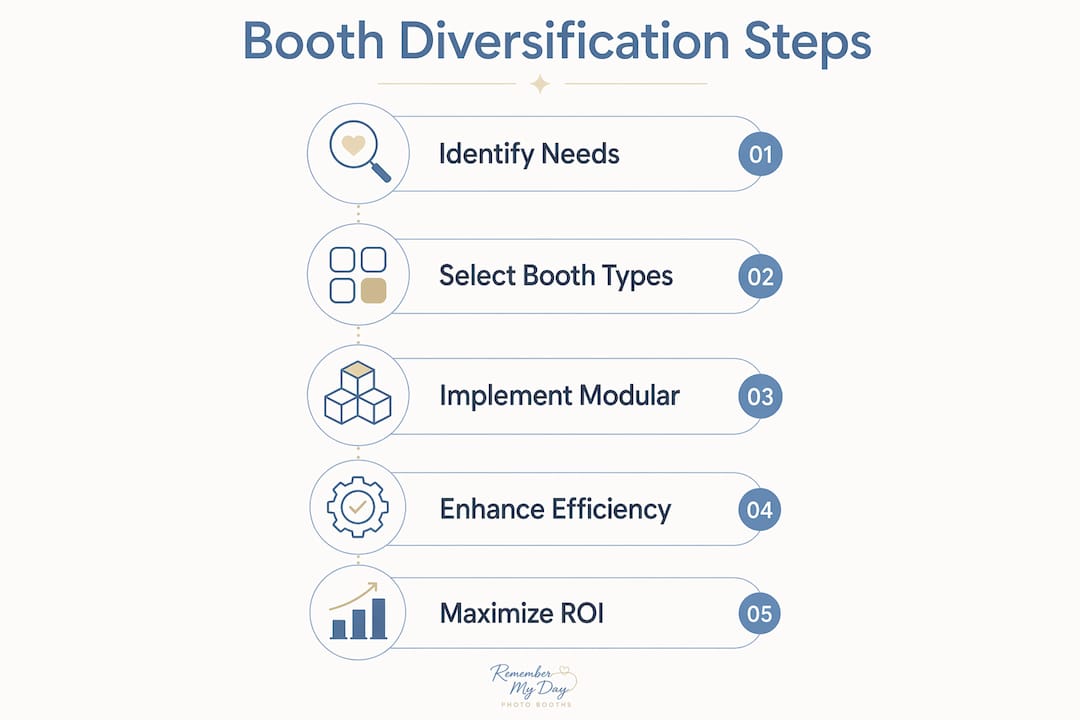
Successful diversification follows a staged approach, not a simultaneous launch of every booth type. Trying to manage five booth formats at once before mastering the operations of one is the fastest route to poor guest experiences and burned-out staff.
-
Start with your strongest booth type. Build cash flow, refine your setup process, and collect client feedback before adding anything new. Most successful operators master one booth before scaling into higher-margin equipment like 360° or robotic booths.
-
Add one new format per quarter. A quarterly expansion pace gives your team time to train, test, and troubleshoot each new booth type without disrupting existing bookings.
-
Design a unified guest flow. Treat diversified booths as a unified funnel rather than isolated activations. When guests move naturally from a traditional print booth to a 360° station, dwell time increases and overall engagement deepens. Place booths in a logical sequence that guides guests through the experience.
-
Use event management software to coordinate multi-booth logistics. Platforms built for hybrid and live event planning help organizers track booth schedules, guest flow data, and setup timelines across multiple activations in one place.
-
Package your booth types into tiered offerings. A “signature” package with one booth, a “premium” package with two, and a “full experience” package with three booths gives clients a clear upgrade path. This structure increases average booking value without requiring a hard sales conversation.
-
Measure engagement by booth type after every event. Track which booths generate the longest lines, the most social shares, and the highest client satisfaction scores. That data tells you where to invest next and which formats to retire.
Offering variety increases share of wallet and customer satisfaction by matching diverse guest preferences. Clients who book a two-booth package once almost always return for a three-booth package the next time.
Key Takeaways
Diversifying booth offerings is the most direct path to higher revenue, stronger client retention, and a more resilient event business.
| Point | Details |
|---|---|
| Revenue ceiling expands with booth variety | 360° booths command $1,500–$3,500 per event, far above single-format pricing. |
| Diversification reduces revenue concentration risk | Spreading offerings across weddings, corporate, and private events stabilizes cash flow. |
| Modular systems cut costs and setup time | Standardized components reduce per-show costs by up to 24% and setup time by up to 60%. |
| Staged expansion prevents operational overload | Master one booth type before adding the next to protect guest experience quality. |
| Unified guest flow multiplies engagement | Designing booths as a connected sequence increases dwell time and satisfaction. |
What we’ve learned from building a diverse booth portfolio
After working hundreds of events across San Antonio, the lesson that sticks with me most is this: guests do not remember the equipment. They remember the moment. A 360° booth creates a “wow” moment. A glam booth makes someone feel like a star. A vintage booth sparks a conversation between generations. The booth type is just the vehicle.
What I have seen trip up even experienced event organizers is treating diversification as a gear acquisition strategy rather than a guest experience strategy. Buying a new booth format without a clear plan for how it fits into the event flow just creates confusion on the floor. The booths that generate the most excitement are always the ones placed intentionally, staffed well, and connected to the event’s overall theme.
The shift happening right now in 2026 is significant. Clients are no longer asking for “a photo booth.” They are asking for a branded guest journey that feels custom to their event. AI-powered portraits, instant digital delivery, and personalized overlays are raising the bar for what guests expect. Operators who diversify into these formats now will own that market for the next several years.
My honest advice: do not wait until a competitor books the 360° booth before you add one. The best time to expand your portfolio is when business is good and you have the cash flow to do it right.
— RMD
Rmdphotobooths brings your event vision to life
At Rmdphotobooths, we have spent years building a portfolio that gives event planners real choices, not just a single option dressed up in different colors. Whether you are planning a San Antonio wedding, a corporate brand activation, or a private celebration, we have a booth experience designed to spark joy and create memories your guests will treasure forever.

From our traditional photo booth to our 360° booth rental, glam setups, vintage options, and AI-powered portrait stations, every format in our lineup is backed by over 1,000 five-star reviews and a team that genuinely loves what we do. We make multi-booth events feel effortless, from setup to the last print of the night. Ready to see everything we offer? Explore our full experiences and find the perfect combination for your next event. When you are ready to make it official, book your booth today and let us help you create those “wow” moments.
FAQ
Why should event planners diversify booth offerings?
Diversifying booth offerings reduces revenue concentration risk and serves a wider range of guest preferences. Operators who offer multiple booth types consistently achieve higher booking values and stronger client retention.
What is the most profitable booth type to add first?
The 360° video booth is the highest-margin expansion for most operators, with per-event pricing reaching $1,500 to $3,500. It appeals strongly to wedding couples and corporate clients seeking premium, shareable experiences.
How does a modular booth system save money?
Modular booth systems use standardized components that reconfigure for different venues, reducing per-show design costs by up to 24% and cutting setup time by up to 60%. Those savings compound across a full season of events.
How many booth types should an event organizer offer?
Start with one booth type, master it, then add one new format per quarter. Most successful operators build to three or four complementary booth types before expanding further.
How do multiple booths improve guest engagement?
Designing multiple booths as a connected guest flow rather than isolated stations increases dwell time and overall satisfaction. Guests who move naturally between experiences engage more deeply and generate more social content from the event.